SSC CGL Model Question Paper (Tier-1 & Tier-2 Latest Pattern): Bilingual Solved Sets with Exam Shortcuts
Complete TCS-CBT pattern model question sets across Reasoning, General Awareness, Quantitative Aptitude, and English Comprehension with step-by-step solutions and formula shortcuts.
Get the complete formatted PDF right in your inbox & instant browser download.
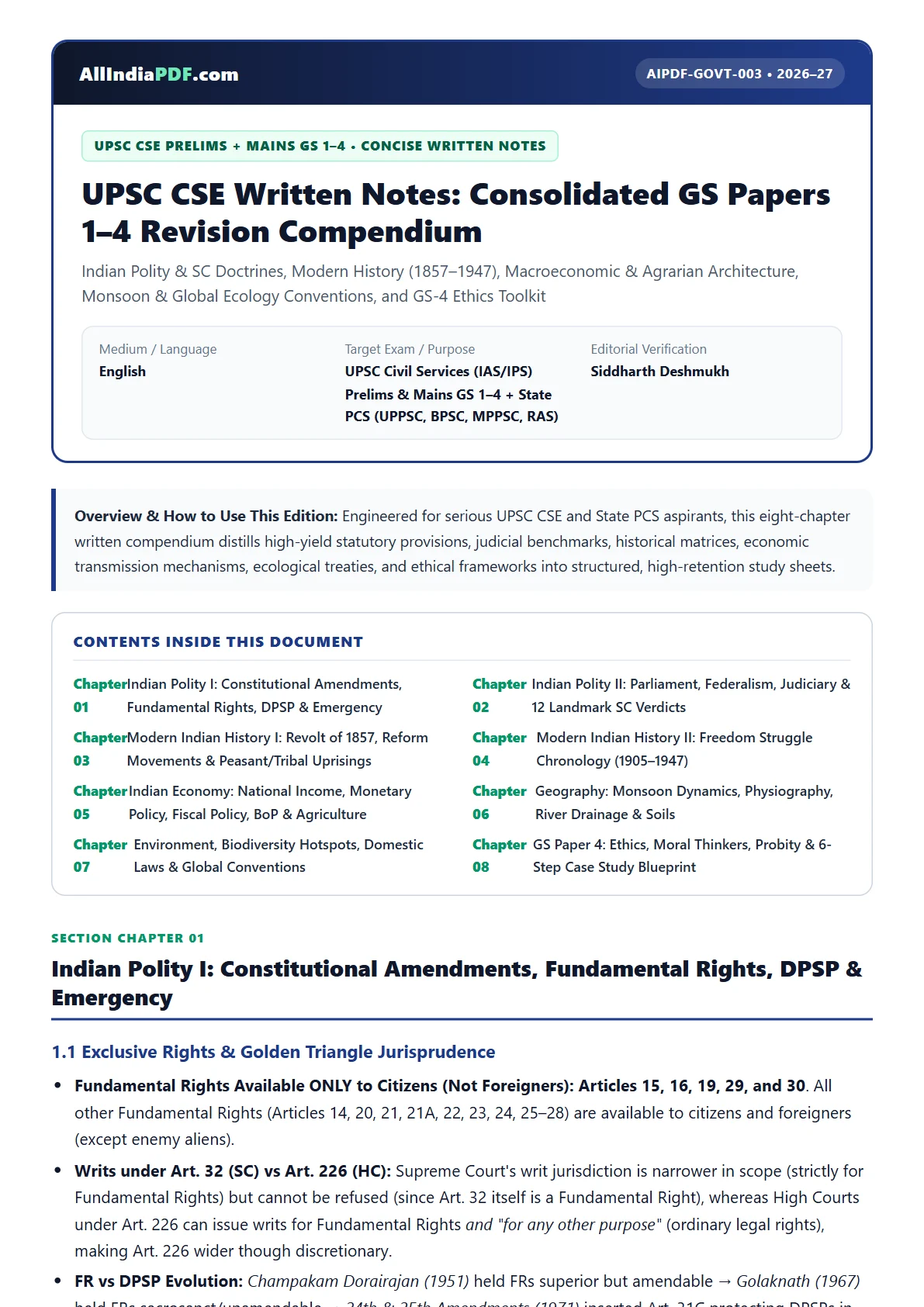
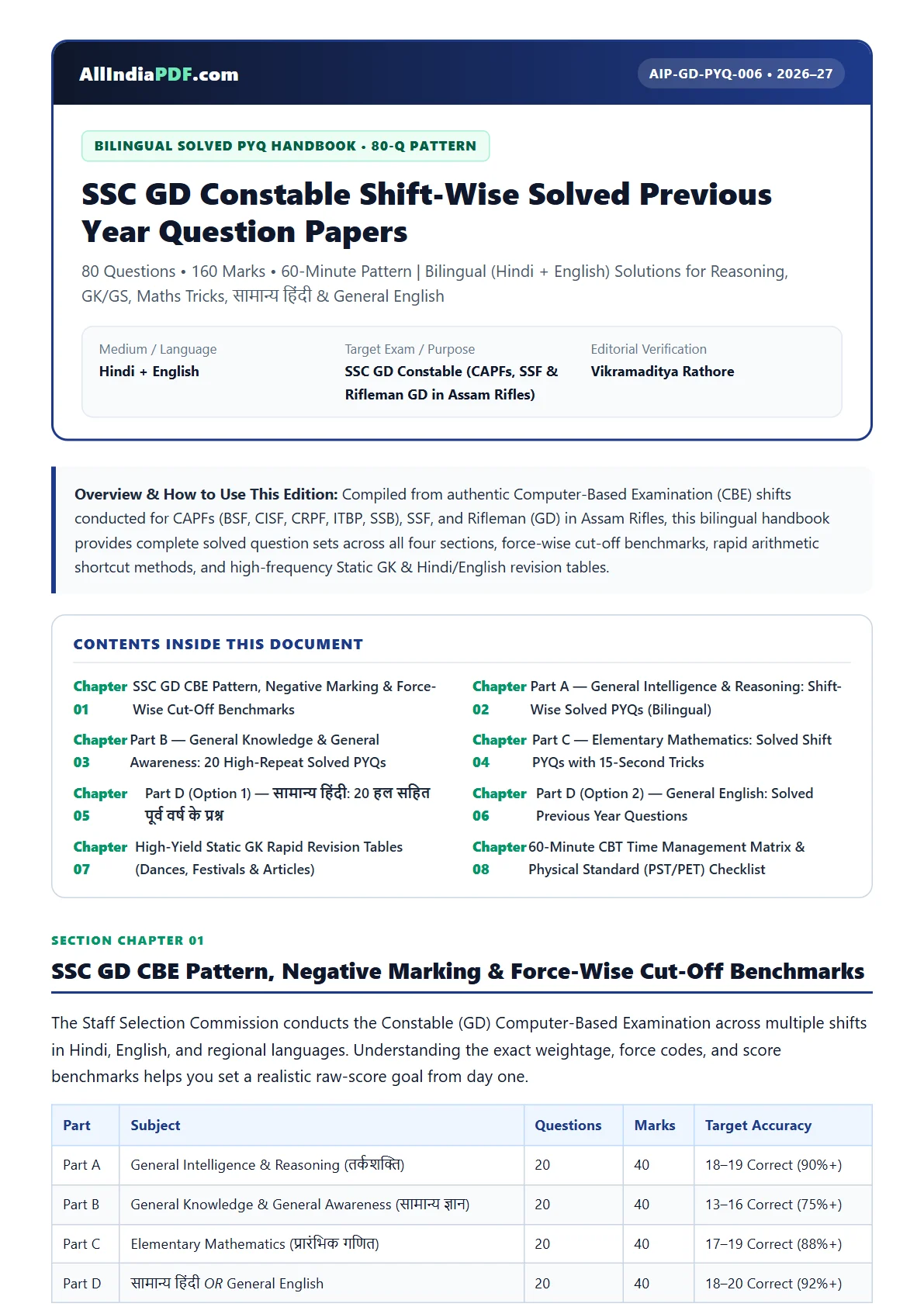
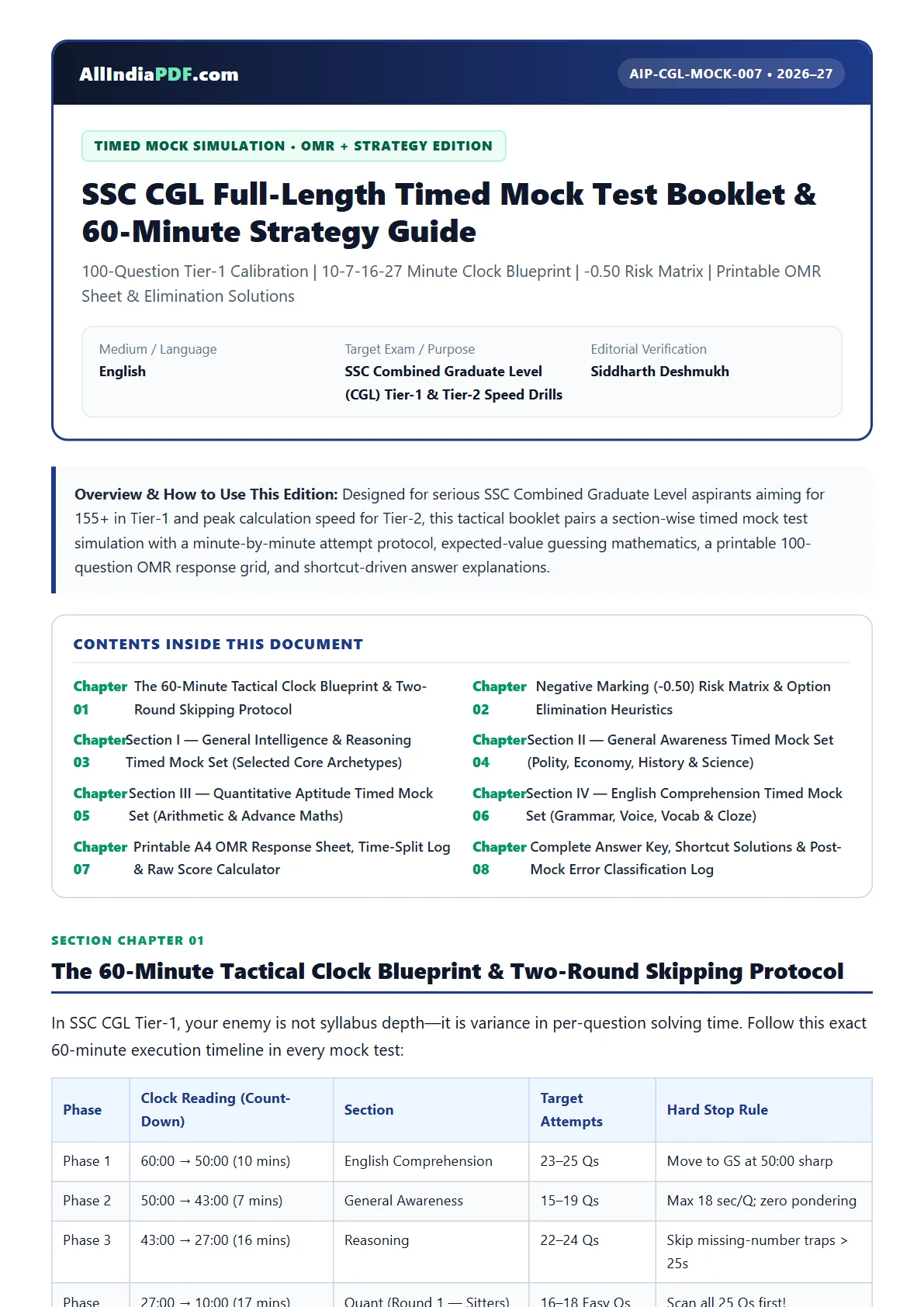
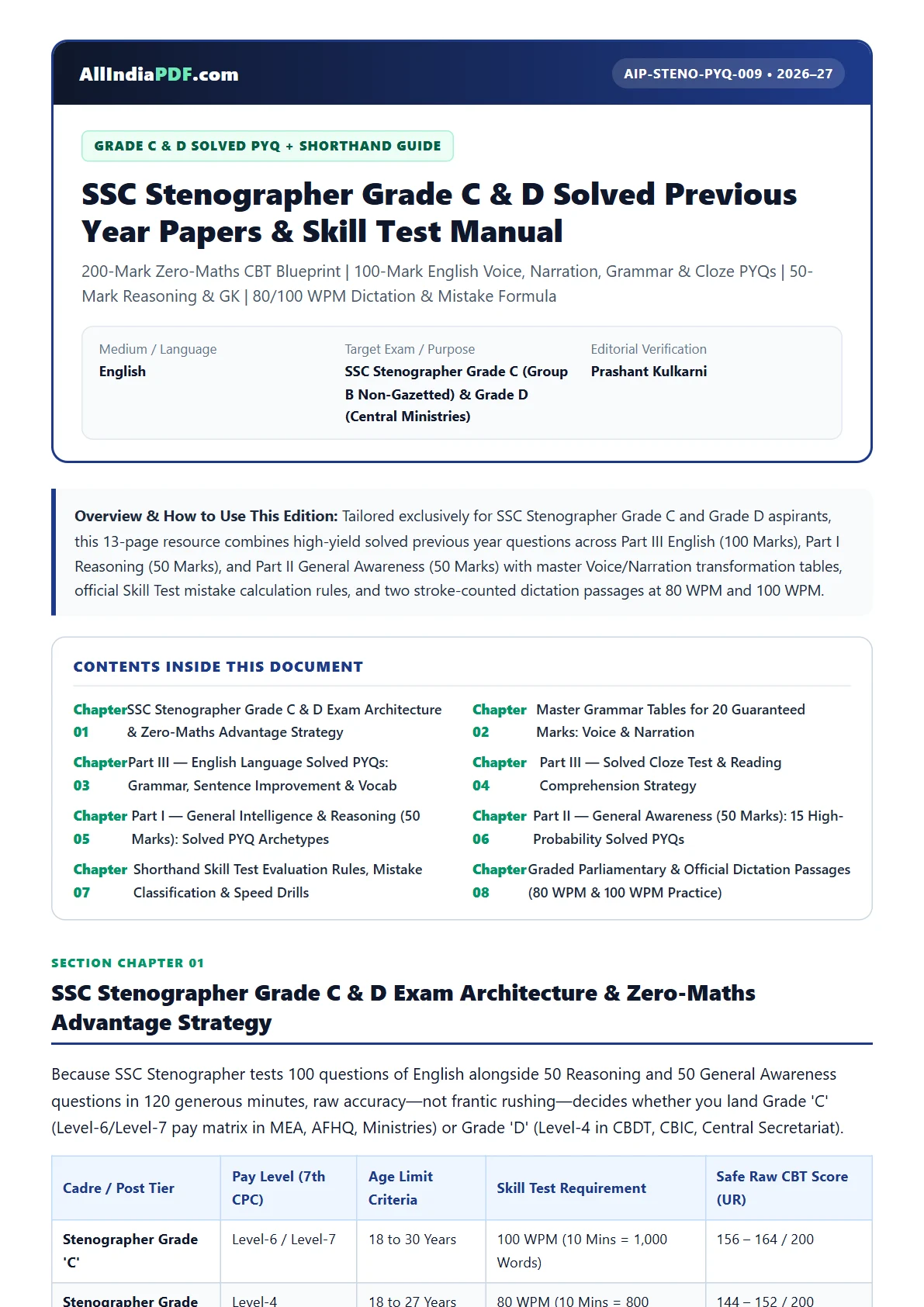
Inside Document Preview (Pages 1–3 of 11)
Actual print-ready pages from the verified 2026–27 PDF compilation.
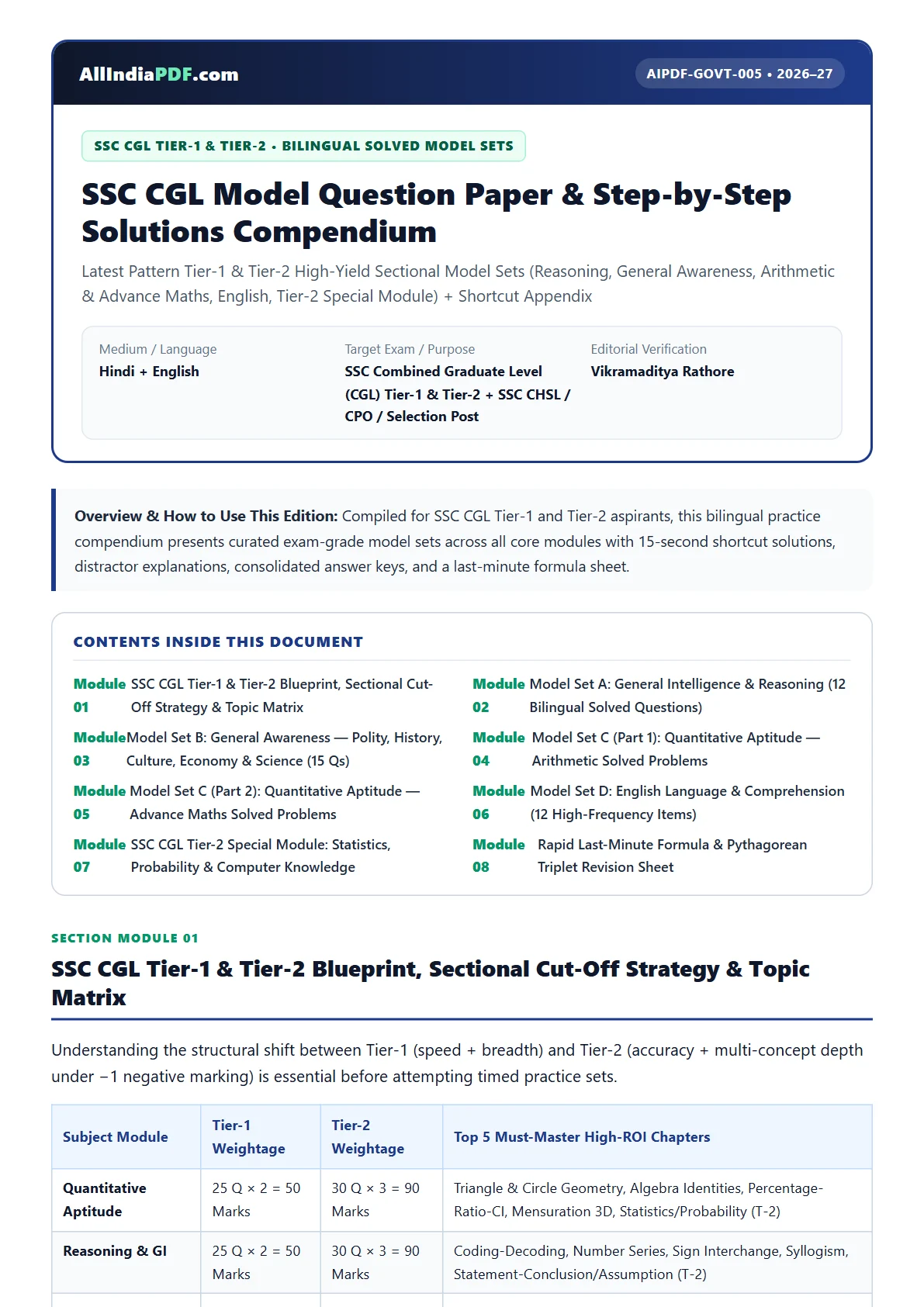
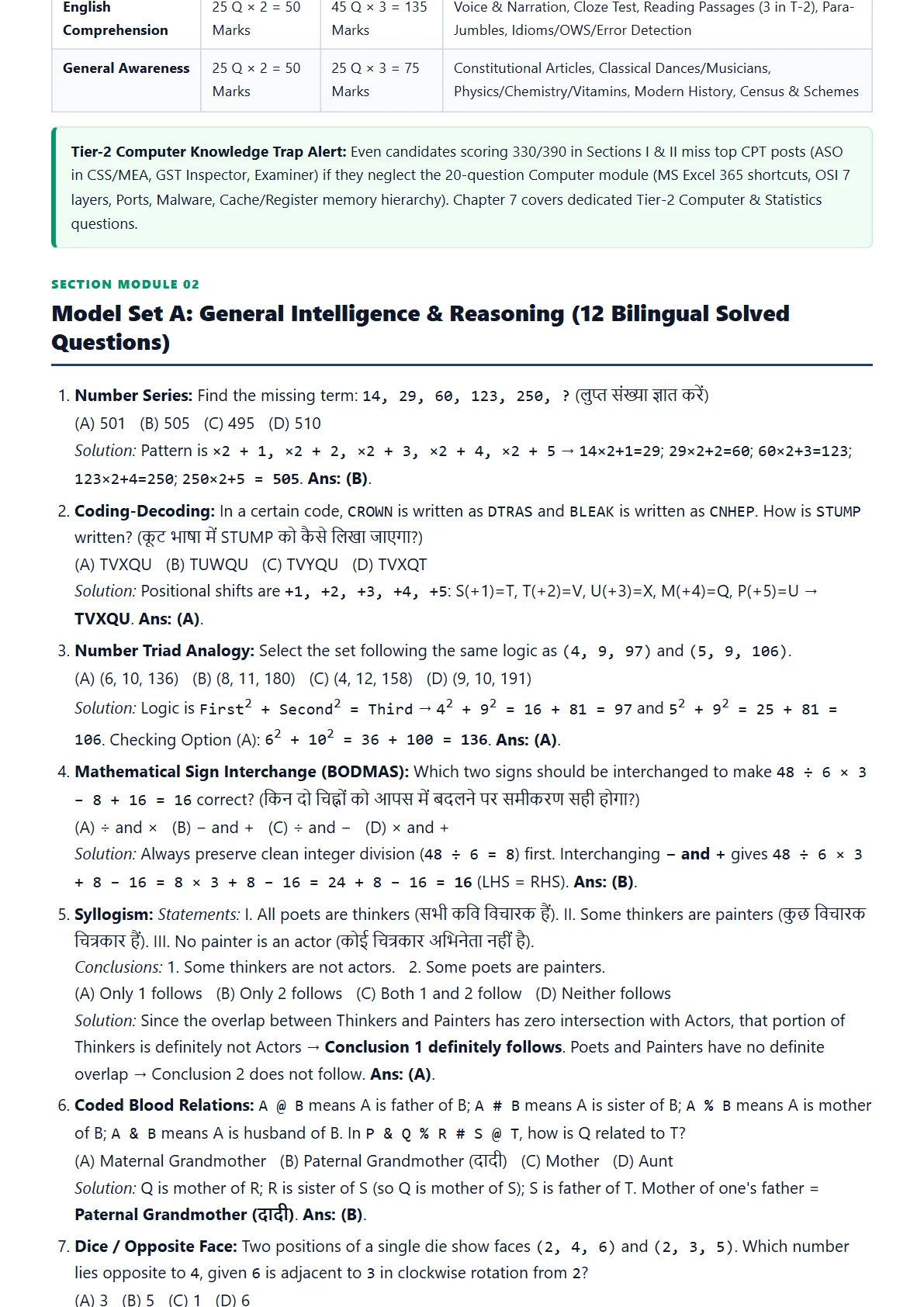
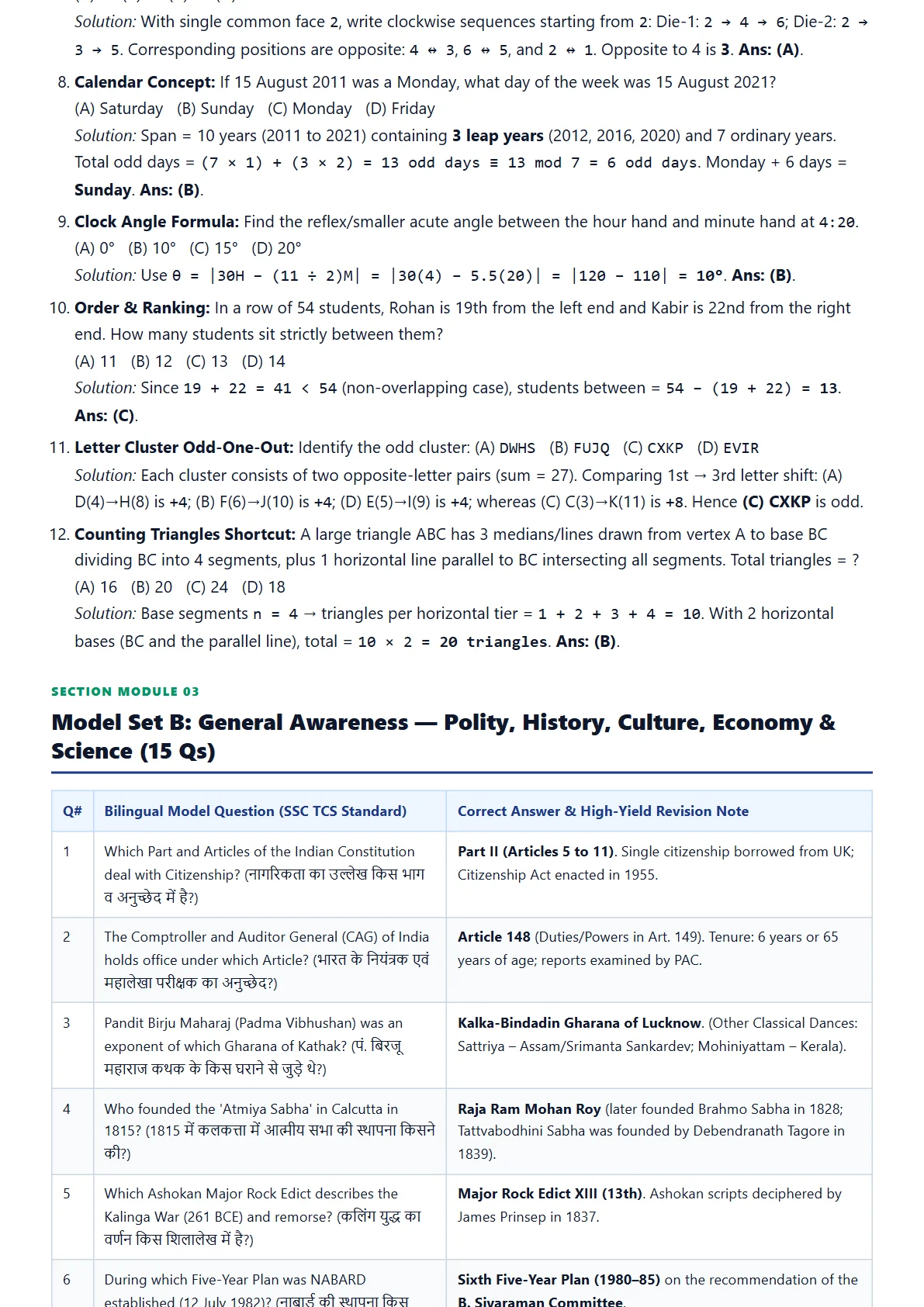
Continue Reading All 11 Full Pages Offline
Verify your email address to access the complete 11-page printable PDF with all chapters, tables, and solved examples.
In This Study Guide
- 1.1. Latest SSC CGL Tier-1 & Tier-2 Official Exam Pattern & Marking Scheme
- 2.2. High-Weightage Topic Distribution Across All Four Sections
- 3.3. Sample Bilingual Solved Model Questions with Exam-Hall Shortcuts
- 4.4. 60-Minute Section-Attempt Strategy for SSC CGL Tier-1
- 5.Complete PDF Chapter Breakdown
- 6.Frequently Asked Questions
Key Highlights
- Strictly aligned with the latest Staff Selection Commission (SSC) CGL Tier-1 (100 Qs, 200 Marks, 60 Mins) and Tier-2 Paper-I Session-I & Session-II computer-based exam pattern
- Bilingual presentation (English + Hindi) for Reasoning, General Awareness, and Quantitative Aptitude questions so aspirants practice in real CBT interface style
- Dual-method Quantitative solutions pairing conceptual clarity with 15-second exam-hall ratio, value-putting, digital-sum, and geometry theorem shortcuts
- High-yield General Awareness explanations covering Articles, Folk/Classical Dances, Five-Year Plans, Chemistry/Biology everyday science, and Modern History
- Includes Tier-2 newly emphasized topics—Probability, Statistics (Mean, Median, Mode, Standard Deviation), Critical Statement-Assumption Reasoning, and Computer Awareness
Cracking the Staff Selection Commission Combined Graduate Level examination requires far more than knowing textbook formulas—it demands instant pattern recognition under a relentless 60-minute clock in Tier-1 and high-accuracy stamina across modular sessions in Tier-2. Practicing a rigorously calibrated cgl model question paper modeled on recent TCS Computer-Based Test (CBT) shifts bridges the gap between chapter-wise learning and scoring 155+ in Tier-1 and 320+ in Tier-2 Paper-I.
Unlike generic unverified question banks filled with outdated 2012-era arithmetic or uncalibrated difficulty spikes, an authentic SSC CGL model paper mirrors the exact cognitive balance of today’s exam: calculation-smart Percentage and CI installments, algebraic symmetry (x + 1/x and a3 + b3 + c3 − 3abc), circle secant-tangent theorems, BODMAS sign-interchange time-traps in Reasoning, statement-based Static GK + Science in General Awareness, and contextual Cloze/Voice/Error detection in English. Below, explore the complete Tier-1 and Tier-2 exam blueprint, topic weightage, representative bilingual solved problems, and pacing strategy.
1. Latest SSC CGL Tier-1 & Tier-2 Official Exam Pattern & Marking Scheme
Tier-1 is qualifying in nature (used to shortlist candidates category-wise for Tier-2), whereas final merit allocation to Group 'B' Gazetted/Non-Gazetted and Group 'C' posts (Inspector of Income Tax, ASO in CSS/MEA/Railways, Central Excise/GST Inspector, Divisional Accountant, Auditor) is determined strictly on the basis of aggregate performance in Tier-2 Paper-I (390 Marks), subject to qualifying Computer Knowledge and Data Entry Speed Test (DEST).
| Exam Stage & Section | No. of Questions | Maximum Marks | Time Allotment & Negative Marking |
|---|---|---|---|
| Tier-1 (All 4 Sections Combined): A. General Intelligence & Reasoning (25 Q) B. General Awareness (25 Q) C. Quantitative Aptitude (25 Q) D. English Comprehension (25 Q) |
100 Questions (25 × 4) |
200 Marks (+2 per Q) |
60 Minutes Composite (−0.50 mark per wrong answer) |
| Tier-2 Paper-I — Section I: Module-I: Mathematical Abilities (30 Q) Module-II: Reasoning & General Intelligence (30 Q) |
60 Questions | 180 Marks (+3 per Q) |
60 Minutes for Section I (−1 mark per wrong answer) |
| Tier-2 Paper-I — Section II: Module-I: English Language & Comprehension (45 Q) Module-II: General Awareness (25 Q) |
70 Questions | 210 Marks (+3 per Q) |
60 Minutes for Section II (−1 mark per wrong answer) |
| Tier-2 Paper-I — Section III (Qualifying): Module-I: Computer Knowledge Test (20 Q) Module-II: Data Entry Speed Test (DEST) |
20 Questions + ~2000 Key Depressions |
60 Marks (Qualifying) |
15 Mins (Computer) + 15 Mins (DEST Session-II) |
2. High-Weightage Topic Distribution Across All Four Sections
Analyzing recent multi-shift CGL papers reveals that nearly 75% of questions originate from a predictable core cluster of sub-topics:
- Quantitative Aptitude (Tier-1: 25 Q | Tier-2: 30 Q): Geometry & Circle Properties (3–4 Q: chord-tangent angles, similar triangles, incenter/circumcenter), Trigonometry & Heights (2–3 Q), Algebra (2–3 Q: cubic identities, reciprocal equations), Mensuration 2D/3D (2–3 Q: cone, cylinder, sphere, frustum, prism), Percentage, Ratio, Mixture & Margin/Discount (4–5 Q), Time & Work / Pipes (2 Q), Time, Speed, Distance, Trains & Races (2 Q), SI-CI Difference (1–2 Q), Data Interpretation (3–4 Q), plus Statistics & Probability (2–3 Q exclusively in Tier-2).
- General Intelligence & Reasoning: Coding-Decoding & Letter Clusters (3–4 Q), Number & Figural Series (3–4 Q), Analogy & Odd-One-Out (3 Q), BODMAS Sign Interchange (2 Q), Syllogism & Coded Blood Relations (3 Q), Dice, Mirror Image & Paper Folding (3–4 Q), and Critical Reasoning (Assumptions/Conclusions/Inferences) in Tier-2.
- General Awareness: Indian Polity (Articles 12–51A, President, Parliament, Amendments — 3–4 Q), History (Indus/Vedic/Maurya/Delhi Sultanate/Freedom Struggle — 4 Q), Static Culture (Classical & Folk Dances, Gharanas, Padma Awardee Musicians, Festivals — 3–4 Q), General Science (Periodic Table, Acids/Bases, Vitamins, Plant/Human Physiology, Units — 4–5 Q), Geography & Census 2011 / Five-Year Plans (3–4 Q), and Last 8–10 Months Current Affairs (4–5 Q).
- English Language & Comprehension: Active–Passive Voice & Direct–Indirect Narration (3–6 Q), Sentence Rearrangement (PQRS Para-Jumbles), Grammatical Error Spotting & Sentence Improvement, Synonyms, Antonyms, Idioms & One-Word Substitutions, and Cloze Passage + Reading Comprehension (3 passages in Tier-2).
3. Sample Bilingual Solved Model Questions with Exam-Hall Shortcuts
Observe how top-rankers compress multi-line textbook equations into 15-second mental steps during the exam:
x + (1 ÷ x) = 5 है, तो x3 + (1 ÷ x3) का मान क्या होगा? / If x + (1 ÷ x) = 5, find the value of x3 + (1 ÷ x3).Options: (A) 125 (B) 110 (C) 140 (D) 115
Shortcut Solution: When
x + (1 ÷ x) = k, directly apply x3 + (1 ÷ x3) = k3 − 3k. Substituting k = 5 gives 53 − 3(5) = 125 − 15 = 110. Correct Answer: (B).
Options: (A) 11 cm (B) 15 cm (C) 8.75 cm (D) 12 cm
Shortcut Solution: By Secant Theorem,
PA × PB = PC × PD. Here PA = AB + BP = 7 + 5 = 12 cm. Thus, 12 × 5 = PC × 4 → PC = 60 ÷ 4 = 15 cm. Trap alert: 15 cm is PC, whereas the question asks for chord CD = PC − PD = 15 − 4 = 11 cm. Correct Answer: (A).
Options: (A) Article 110 (B) Article 123 (C) Article 213 (D) Article 143
Explanation: Article 123 vests Ordinance-making power in the President (maximum life 6 months + 6 weeks from reassembly), whereas Article 213 vests parallel power in the Governor of a State, Art. 110 defines Money Bills, and Art. 143 covers Supreme Court advisory jurisdiction. Correct Answer: (B).
4. 60-Minute Section-Attempt Strategy for SSC CGL Tier-1
In Tier-1, all 100 questions share a single uninterrupted 60-minute timer. Starting with lengthy Quantitative calculations often drains 35 minutes and triggers panic during easy English and GK questions. Follow this proven two-round sequence:
| Attempt Order | Section | Ideal Time Budget | Tactical Execution Rule |
|---|---|---|---|
| 1st | General Awareness (25 Q) | 6 – 7 Minutes | Pure recall & option elimination; never overthink unknown factual traps. |
| 2nd | English Comprehension (25 Q) | 10 – 12 Minutes | Solve Voice, Narration, Error & Vocab rapidly; read Cloze passage holistic tone first. |
| 3rd | General Intelligence & Reasoning (25 Q) | 16 – 18 Minutes | Skip stubborn missing-number/series traps for Round 2 if unsolved in 40 seconds. |
| 4th | Quantitative Aptitude (25 Q) | 22 – 24 Minutes | Sweep 18–20 direct formula/ratio questions in Round 1; use remaining 3 mins for marked items. |
What’s Included Inside the Complete 11-Page PDF
Structured specifically for fast revision, exam hall recall, and clean A4 printing:
Latest SSC CGL Tier-1 & Tier-2 Exam Pattern & Topic Weightage
Exact section-wise question counts, marks per question, negative marking rules (−0.50 in Tier-1, −1 in Tier-2), and shift-analyzed topic priority tables.
Sectional Model Set A: General Intelligence & Reasoning (Solved)
High-frequency problems on Number/Letter Series, Coding-Decoding, Mathematical Operations, Syllogism, Blood Relations, Cube/Dice, and Embedded Logic.
Sectional Model Set B: General Awareness Static + Conceptual (Solved)
20 curated questions with 4-option elimination notes across Indian Polity, Ancient/Modern History, Geography, Macroeconomics, Classical Arts, and General Science.
Sectional Model Set C: Quantitative Aptitude — Arithmetic & Advance (Solved)
20 multi-concept model problems spanning Percentage, Ratio, CI-SI, Time & Work, Speed-Distance, Algebra, Trigonometry, Circle Geometry, and 3D Mensuration.
Sectional Model Set D, Tier-2 Special Module & Master Formula Appendix
20 solved English Grammar/Vocab/Voice/Narration/Cloze questions, Tier-2 Statistics/Probability/Computer set, consolidated Answer Key, and rapid revision formulas.
Ready to download the full 11-page printable PDF?
Instant access + backup copy delivered straight to your verified email address.
Frequently Asked Questions
Is this SSC CGL Model Question Paper based on the latest Tier-1 and Tier-2 pattern?+
Yes. Both the exam blueprint and every model set follow the current SSC CGL syllabus, including qualifying Tier-1 (100 Qs) and merit-deciding Tier-2 Paper-I modules covering Statistics, Probability, Statement-Assumption Critical Reasoning, and Computer Knowledge.
Are the model questions provided in both Hindi and English?+
Yes. Just like the real SSC CBT screen, Reasoning, General Awareness, and Quantitative Aptitude questions are framed bilingually (English + Devanagari Hindi) alongside clear step-by-step solutions.
How are these model papers different from a raw previous-year answer key?+
Raw answer keys only mark the right option without explaining why distractors are wrong or showing faster exam-hall methods. Here, every Quantitative and Reasoning problem demonstrates shortcut logic (ratio method, symmetry, secant/chord properties, option elimination), and every GK/English question explains all four options.
Are Tier-1 marks added to the final merit list in SSC CGL?+
No. Under the revised SSC CGL notification rules, Tier-1 is strictly qualifying to shortlist candidates for Tier-2. Final post allocation is prepared exclusively from Tier-2 marks (subject to clearing sectional cut-offs, Computer Knowledge, and DEST).
Will practicing these CGL model sets also help in SSC CHSL, CPO, and Selection Post exams?+
Yes. SSC CGL, CHSL, CPO, and Graduate-Level Selection Post exams are conducted by the same commission with overlapping TCS question frameworks across Arithmetic, Advance Maths, Reasoning, Static GK, and English Grammar.
Editorial Accuracy & Syllabus Verification (2026–27)
This guide was compiled by Vikramaditya Rathore (Quantitative Aptitude & SSC Exam Strategist (Cleared SSC CGL 3× — ASO CSS)) and reviewed by Neha Bansal (English & Reasoning Content Editor for Competitive CBT Examinations) in accordance with our Editorial Policy. Found a syllabus update or typo? Write to support@allindiapdf.com.