SSC CGL Mock Test Practice Booklet with OMR Sheet & 60-Minute Strategy
Timed Full-Length Tier-1 Simulation (100 Questions, 200 Marks), Minute-by-Minute Attempt Sequence, Negative Marking (-0.50) Risk Matrix, and Elimination Explanations
Get the complete formatted PDF right in your inbox & instant browser download.
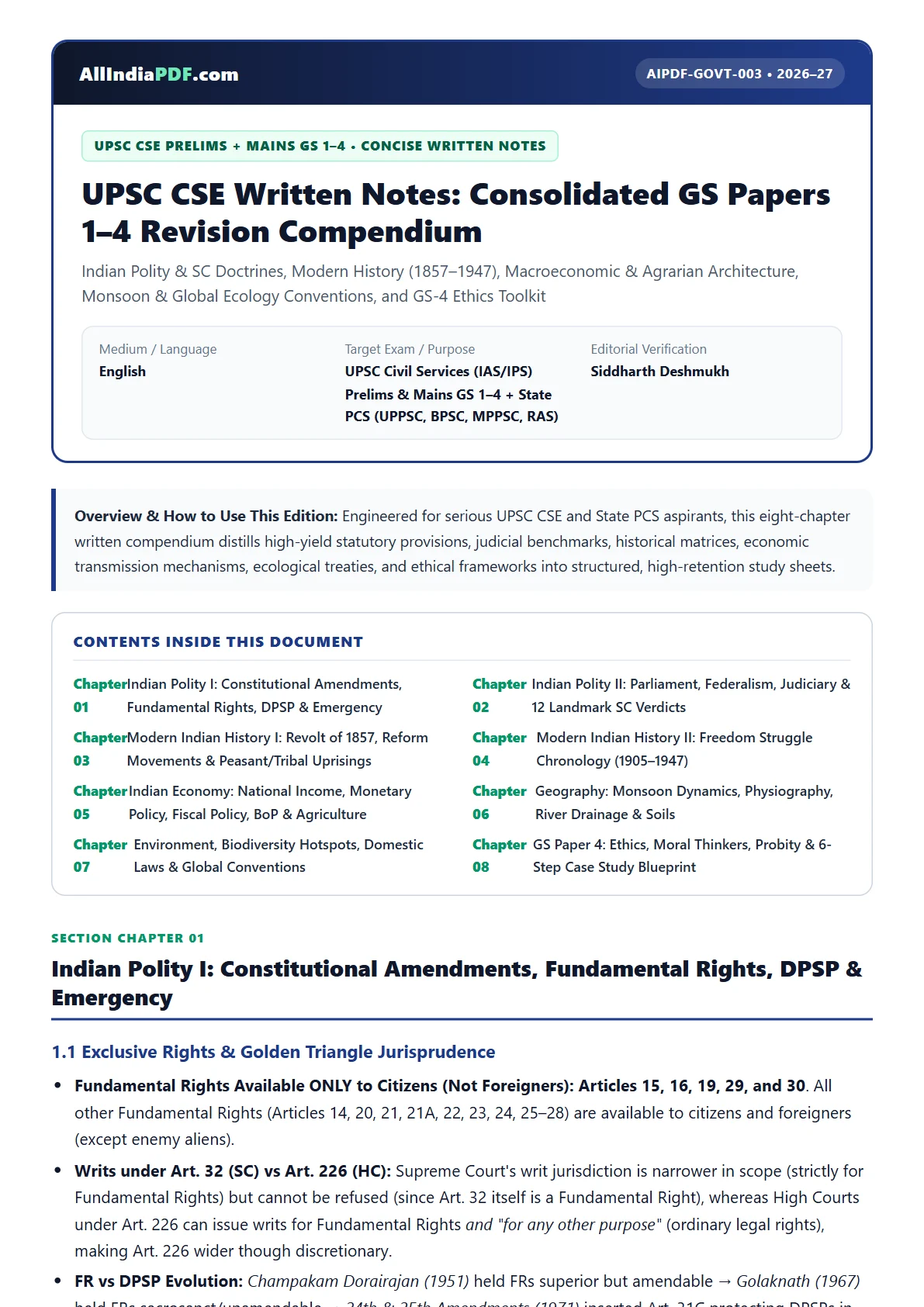
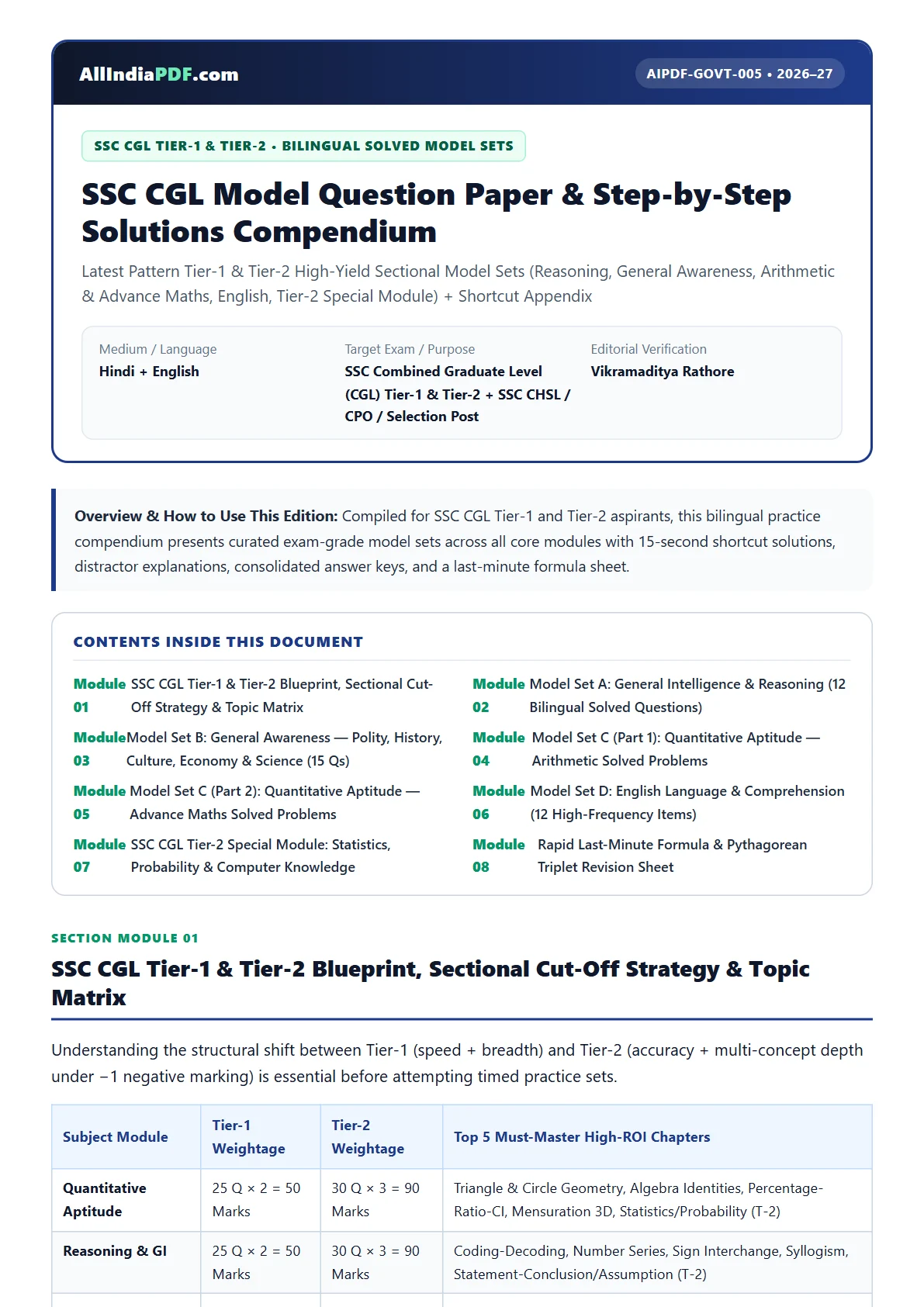
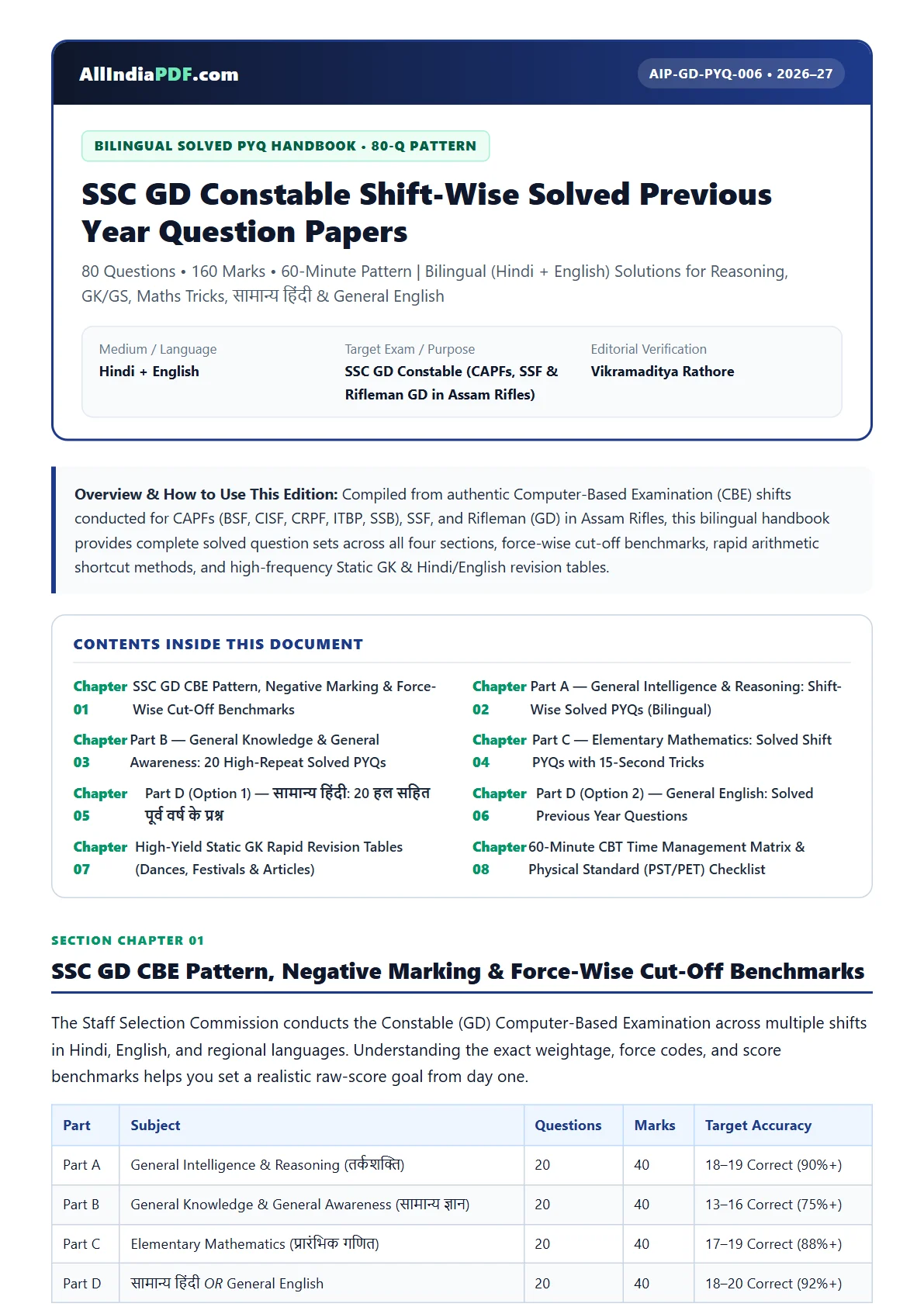
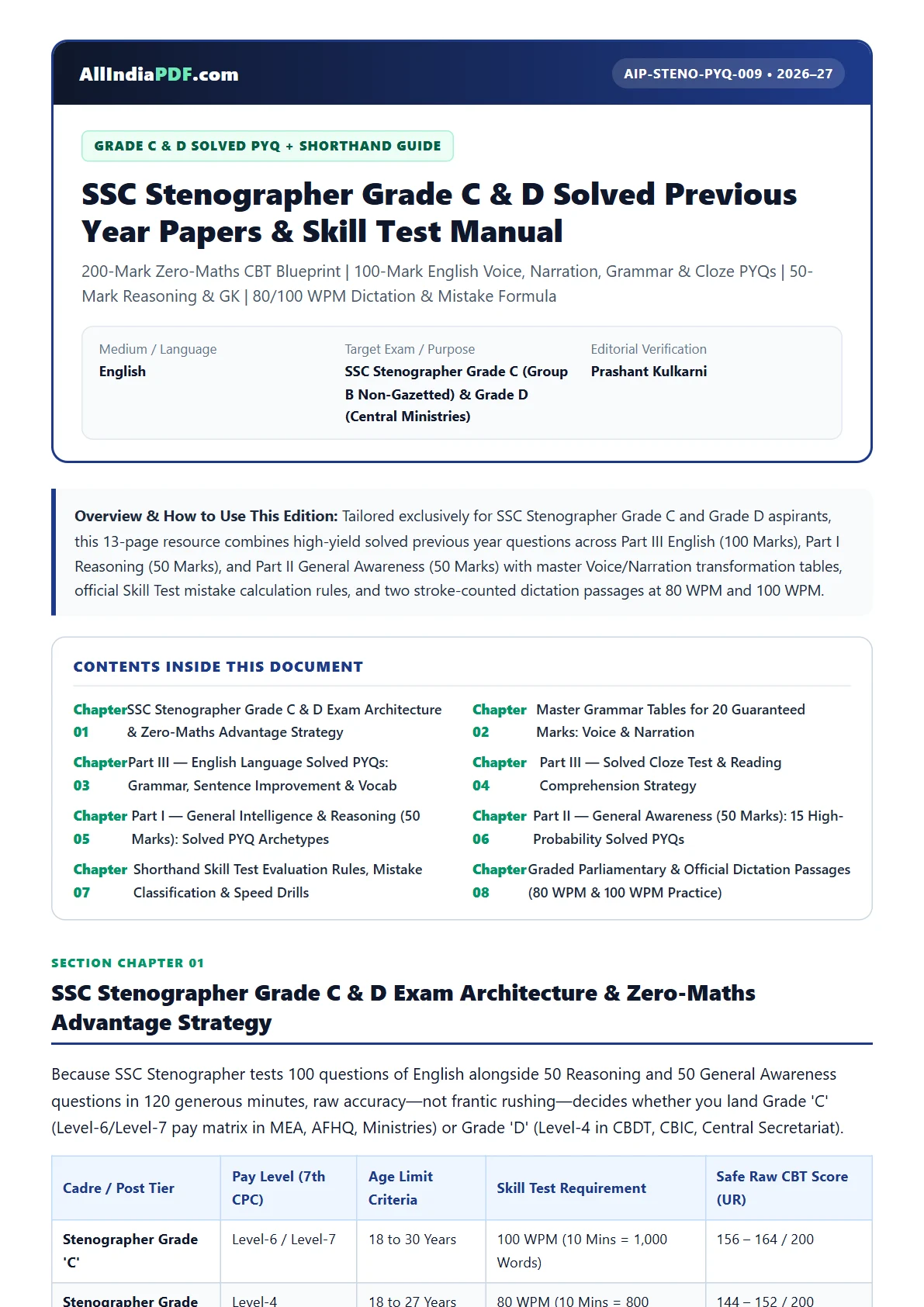
Inside Document Preview (Pages 1–3 of 9)
Actual print-ready pages from the verified 2026–27 PDF compilation.
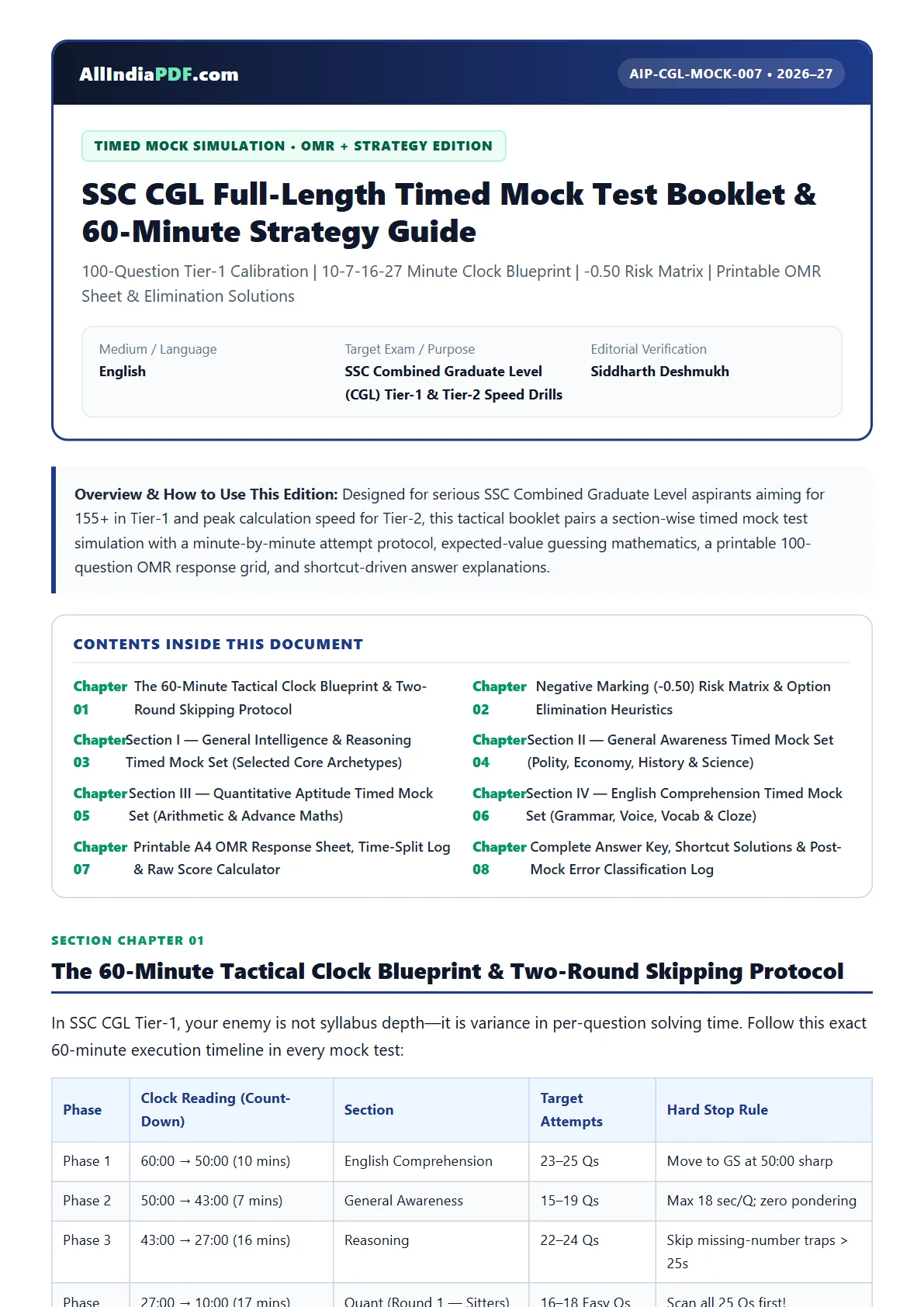
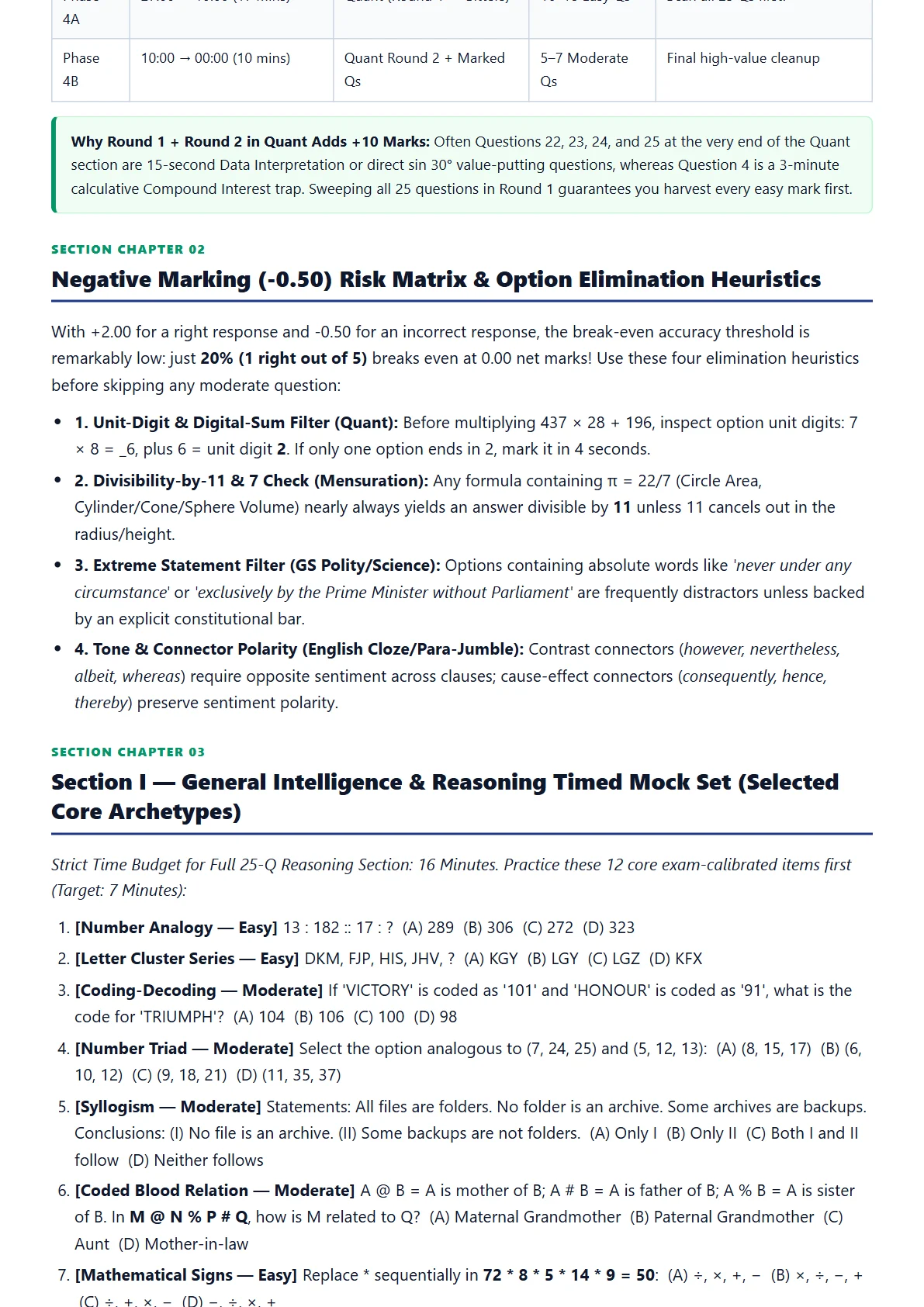
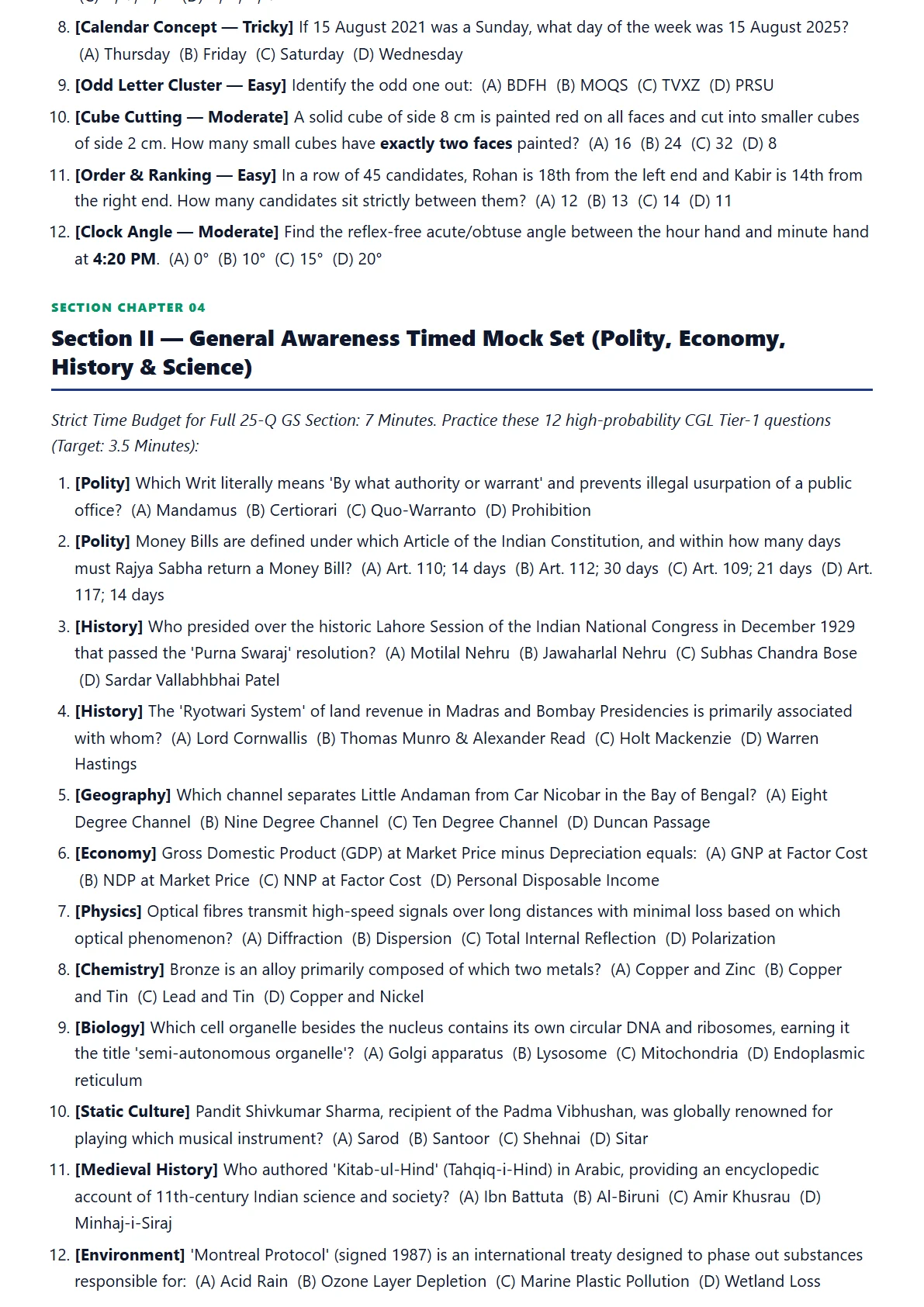
Continue Reading All 9 Full Pages Offline
Verify your email address to access the complete 9-page printable PDF with all chapters, tables, and solved examples.
In This Study Guide
- 1.The Proven 60-Minute Exam Hall Attempt Order (10m → 7m → 16m → 27m)
- 2.Negative Marking (-0.50) Expected-Value Risk Matrix
- 3.Diagnostic Mini-Mock Sample: Test Your Speed Across All 4 Sections
- 4.Elimination Walkthrough & Solutions for the Diagnostic Mini-Mock
- 5.Post-Mock Analysis Protocol & Score-to-Readiness Benchmarks
- 6.Complete PDF Chapter Breakdown
- 7.Frequently Asked Questions
Key Highlights
- Engineered specifically as a Timed 60-Minute Simulation Booklet—not an untimed chapter bank
- Proven 10m → 7m → 16m → 27m section attempt order used by top-percentile qualifiers
- Mathematical Negative Marking (-0.50) Expected-Value Risk Matrix for smart option elimination
- Balanced Easy / Moderate / Tricky difficulty calibration matching real multi-shift TCS papers
- Includes Printable A4 100-Bubble OMR Response Grid, Time-Split Log, and Mistake Tracker
Every year, tens of thousands of graduates who thoroughly know every theorem in geometry, arithmetic, and English grammar still miss the Tier-1 cut-off by 4 to 8 marks. The culprit is rarely conceptual ignorance—it is clock collapse. Attempting an ssc cgl mock test of 100 questions (200 marks) inside a relentless 60-minute composite window gives you an average of just 36 seconds per question, including reading, rough work, and option selection.
Unlike topic-wise previous year compilations or untimed model papers, this dedicated Timed Mock Test Practice Guide focuses entirely on execution under pressure: which section to open first at Minute 00:00, when to abandon an ego-trap calculation question within 15 seconds, how the -0.50 negative marking mathematics governs two-option guesses, and how to audit every mock test using a structured Error Classification Log.
The Proven 60-Minute Exam Hall Attempt Order (10m → 7m → 16m → 27m)
Opening Quantitative Aptitude at Minute 00:00 is the single costliest strategic blunder in SSC CGL. Cold-starting with heavy arithmetic spikes adrenaline, burns 35+ minutes on 20 questions, and forces panic-reading in English and Reasoning at the end. Top qualifiers reverse this friction by banking 100 marks worth of non-calculative sections in the first 17 minutes:
| Attempt Order | Tier-1 Section | Questions / Marks | Strict Clock Window | Primary Objective |
|---|---|---|---|---|
| Slot 1 | English Comprehension | 25 Qs / 50 Marks | Minute 00 to 10 (10m) | Warm up reading speed; bank 42–46 marks rapidly |
| Slot 2 | General Awareness (GS) | 25 Qs / 50 Marks | Minute 10 to 17 (7m) | Instant recall + 50:50 elimination; zero time waste |
| Slot 3 | General Intelligence & Reasoning | 25 Qs / 50 Marks | Minute 17 to 33 (16m) | Solve 21–22 direct Qs; skip stubborn number-set traps |
| Slot 4 | Quantitative Aptitude | 25 Qs / 50 Marks | Minute 33 to 60 (27m) | Round 1 (18 easy Qs in 17m) + Round 2 (moderate Qs in 10m) |
The 15-Second Ego-Trap Rule: In Reasoning (especially Missing Number / Analogous Number Triad sets like (14, 112, 392)) and Quantitative Aptitude, if the core logic does not click within 15 seconds, mark the question for review immediately and move on. Every question carries an identical +2.0 marks—solving three easy DI/Trigonometry questions in 90 seconds yields +6.0 marks, whereas wrestling with one ego-trap triad yields at best +2.0 marks.
Negative Marking (-0.50) Expected-Value Risk Matrix
In SSC CGL Tier-1, each right answer awards +2.00 marks and each wrong answer deducts -0.50 marks (1/4th penalty). Many students mistakenly believe they should never guess unless 100% certain. Probability mathematics proves otherwise when you can eliminate options:
| Scenario on 10 Questions | Options Eliminated | Probability of Right Choice | Expected Right / Wrong | Net Marks Impact | Tactical Verdict |
|---|---|---|---|---|---|
| 100% Conceptual Certainty | 3 Eliminated | 100% (1 in 1) | 10 Right / 0 Wrong | +20.00 Marks | Mandatory Attempt |
| Two-Option Narrow Down | 2 Eliminated (50:50) | 50% (1 in 2) | 5 Right / 5 Wrong | +7.50 Marks (10 − 2.5) | Always Attempt! (+0.75 EV/Q) |
| One-Option Elimination | 1 Eliminated (1 in 3) | 33.3% (1 in 3) | 3.33 Right / 6.67 Wrong | +3.33 Marks | Attempt only if low on overall count |
| Pure Blind Guess | 0 Eliminated (1 in 4) | 25% (1 in 4) | 2.5 Right / 7.5 Wrong | +1.25 Marks (High Variance) | Strictly Avoid (Risk of -5 streak) |
Diagnostic Mini-Mock Sample: Test Your Speed Across All 4 Sections
Set a stopwatch for 5 minutes 30 seconds and solve these 8 calibrated questions (2 per section) before checking the elimination walkthroughs in the next section:
- Q1 [English — Active/Passive | Target: 12 sec | Easy]: Convert to Passive Voice: "The panel is reviewing the audit discrepancies."
(A) The audit discrepancies have been reviewed by the panel. (B) The audit discrepancies are being reviewed by the panel.
(C) The audit discrepancies were being reviewed by the panel. (D) The audit discrepancies are reviewed by the panel. - Q2 [English — Grammar Error | Target: 20 sec | Moderate]: Identify the erroneous segment: "Scarcely had the train arrived at the platform (1) / than the passengers rushed (2) / towards the unreserved coaches. (3) / No error (4)"
- Q3 [General Awareness — Polity | Target: 15 sec | Easy]: Joint sitting of both Houses of Parliament under Article 108 is summoned by whom and presided over by whom?
(A) Summoned & presided by President (B) Summoned by Speaker, presided by Vice-President
(C) Summoned by President, presided by Lok Sabha Speaker (D) Summoned by Prime Minister, presided by Speaker - Q4 [General Awareness — Economics | Target: 20 sec | Moderate]: When the Reserve Bank of India increases the Cash Reserve Ratio (CRR), what is the immediate impact on commercial banks' credit creation capacity?
(A) Credit creation expands (B) Credit creation contracts (C) Remains unchanged (D) Fiscal deficit doubles - Q5 [Reasoning — Number Triad | Target: 35 sec | Moderate]: Select the set related in the same way as (8, 15, 17) and (12, 35, 37):
(A) (9, 40, 41) (B) (10, 24, 28) (C) (7, 21, 25) (D) (11, 50, 52) - Q6 [Reasoning — Coding | Target: 30 sec | Moderate]: If 'STATUS' = 98 and 'POLICY' = 78, find the code for 'BUDGET'.
(A) 57 (B) 61 (C) 59 (D) 55 - Q7 [Quant — Algebra | Target: 35 sec | Moderate]: If x + (1 ÷ x) = 5, find the exact value of x3 + (1 ÷ x3).
(A) 125 (B) 110 (C) 140 (D) 115 - Q8 [Quant — Geometry | Target: 45 sec | Tricky]: Two chords AB and CD of a circle intersect internally at point P. If AP = 6 cm, PB = 8 cm, and CP = 4 cm, find the total length of chord CD.
(A) 12 cm (B) 16 cm (C) 14 cm (D) 10 cm
Elimination Walkthrough & Solutions for the Diagnostic Mini-Mock
Notice how top scorers solve the 8 questions above without writing full equations:
• Voice Tense Preservation: 'is + V-ing' MUST map to 'is/are + being + V3'
• Correlative Conjunction Pair: Hardly / Scarcely ... when (never 'than')
• Algebra Identity: If x + 1/x = k, then x3 + 1/x3 = k3 − 3k
• Intersecting Chords Theorem: AP × PB = CP × PD (Read carefully whether PD or CD is asked!)
- Q1 → (B): Do not even read the full sentence! Scan only the verb: is reviewing → plural object takes are being reviewed. Eliminate A, C, D in 6 seconds.
- Q2 → Segment (2): 'No sooner' pairs with than, whereas 'Hardly / Scarcely' always pairs with when / before. Replace than with when.
- Q3 → (C): Classic SSC trap! The President summons a joint sitting (Art. 108), while the Speaker of Lok Sabha presides (in the Speaker's absence, Deputy Speaker of Lok Sabha, then Deputy Chairman of Rajya Sabha—never the Vice-President/Chairman because he is not a member of either House).
- Q4 → (B): Higher CRR forces banks to park a larger fraction of deposits idle with the RBI, shrinking lendable reserves and contracting credit creation (anti-inflationary tool).
- Q5 → (A): Instantly recognize Pythagorean Triplets! 82 + 152 = 172 and 122 + 352 = 372. Option (A) (9, 40, 41) satisfies 81 + 1600 = 1681.
- Q6 → (A) 57: Rule = (Sum of alphabetical positions) − (Number of vowels in the word). For STATUS: 19+20+1+20+21+19 = 100, minus 2 vowels (A, U) = 98. For POLICY: 16+15+12+9+3+25 = 80, minus 2 vowels (O, I) = 78. For BUDGET: 2+21+4+7+5+20 = 59, minus 2 vowels (U, E) = 57.
- Q7 → (B) 110: Apply k3 − 3k directly for k = 5: 53 − 3(5) = 125 − 15 = 110.
- Q8 → (B) 16 cm: By the Intersecting Chords Theorem, AP × PB = CP × PD → 6 × 8 = 4 × PD → PD = 12 cm. Beware of the #1 distractor (Option A: 12 cm)! The question asks for the total length of chord CD = CP + PD = 4 + 12 = 16 cm.
Post-Mock Analysis Protocol & Score-to-Readiness Benchmarks
Taking ten mock tests without post-test diagnostics repeats the same stagnation loop, whereas analyzing three mocks deeply exposes exact mark leaks. Spend at least 40 minutes after every 60-minute simulation filling out a three-column Mistake Ledger:
- Column 1 — Silly Execution Errors (Target: Zero): Misreading 'incorrect' vs 'correct', computing radius instead of diameter, or marking PD instead of CD. Highlight the final five words of every Quant/Reasoning stem to eliminate these instant -2.50 mark swings (+2 lost plus -0.50 penalty).
- Column 2 — Slow Correct Answers (> 75 Seconds): Even if you got +2.0 marks, any arithmetic or geometry problem that consumed 2+ minutes starved three other questions of clock time. Replace conventional x-variable equations with ratio scaling, alligation, or smart value-putting (θ = 45° or a = 1, b = 1, c = −2 where valid).
- Column 3 — Recurring Static & Vocab Gaps: Maintain a single 15-page rapid-revision notebook exclusively for missed Idioms, One-Word Substitutions, Fixed Prepositions, Articles, Folk Dances, and Science Laws encountered in mocks.
Benchmarking Your Raw Mock Score (Out of 200): Below 115 indicates foundational syllabus gaps requiring chapter revision; 120 to 138 indicates solid conceptual grasp held back by slow Quant/Reasoning transitions; 140 to 154 places you right in the live cut-off battleground where eliminating 3 silly mistakes guarantees qualification; and 155+ consistently signals strong readiness for both Tier-1 clearance and Tier-2 merit competition.
What’s Included Inside the Complete 9-Page PDF
Structured specifically for fast revision, exam hall recall, and clean A4 printing:
60-Minute Tactical Clock Protocol
Exact minute-by-minute checkpoints for English (10m), GS (7m), Reasoning (16m), and Quant (27m) with two-round skipping rules.
Full-Spectrum Timed Mock Test Questions
Exam-calibrated questions across all four Tier-1 sections tagged with target solve times and difficulty ratings.
Printable OMR Grid & Score Calculator
Dedicated bubble sheet and raw-score formula worksheet (+2.0 / -0.50) to simulate zero-pause exam pressure offline.
Elimination-First Solution Walkthroughs
Learn unit-digit checks, value substitution, degree-of-freedom tricks, and grammar triggers instead of lengthy textbook methods.
Ready to download the full 9-page printable PDF?
Instant access + backup copy delivered straight to your verified email address.
Frequently Asked Questions
What is the ideal mock test score to safely clear SSC CGL Tier-1?+
Targeting a raw score of 150 to 160+ out of 200 in full-length 60-minute mock tests provides a safe cushion above recent Unreserved cut-offs across moderate and tough shifts.
How often should I take a full-length SSC CGL mock test?+
Beginners who have completed 60% of the syllabus should take 2 mocks per week, rising to 1 timed mock daily during the final 30 days before the examination, paired with a mandatory 45-minute post-mock analysis.
Why use a printable OMR sheet if SSC CGL is an online CBT exam?+
Practicing offline timed sets with an OMR bubble grid eliminates mobile notifications, trains eye-to-paper focus, and slightly over-trains your speed (bubbling takes ~3 minutes), making the real mouse-click CBT interface feel 5% faster.
Should I attempt Quantitative Aptitude first or last in SSC CGL Tier-1?+
Attempting Quantitative Aptitude in the final 26–28 minutes (after English, GS, and Reasoning) protects you from early time-traps and ensures you never leave easy 5-second questions unseen in other sections.
How do I calculate my raw score in an SSC CGL Tier-1 mock test?+
Multiply your total correct answers by 2 and subtract 0.50 for every incorrect answer: Raw Score = (2 × Correct) − (0.50 × Wrong). Unattempted questions carry zero penalty.
Editorial Accuracy & Syllabus Verification (2026–27)
This guide was compiled by Siddharth Deshmukh (Quantitative & Tactical Test-Prep Mentor (Cleared SSC CGL 3 Times)) and reviewed by Ananya Chatterjee (Senior Assessment Editor & Psychometric Test Designer) in accordance with our Editorial Policy. Found a syllabus update or typo? Write to support@allindiapdf.com.