Handwritten Notes UPSC: Visual Revision Maps, Memory Grids & Mains Diagram Frameworks
Built on the 1/10th Compression Rule—high-yield Constitutional Article grids, 1905–1947 Freedom Struggle matrices, Drainage & Pass tables, Environment conventions, Macro-Fiscal flowcharts, and GS Mains visual schematics.
Get the complete formatted PDF right in your inbox & instant browser download.
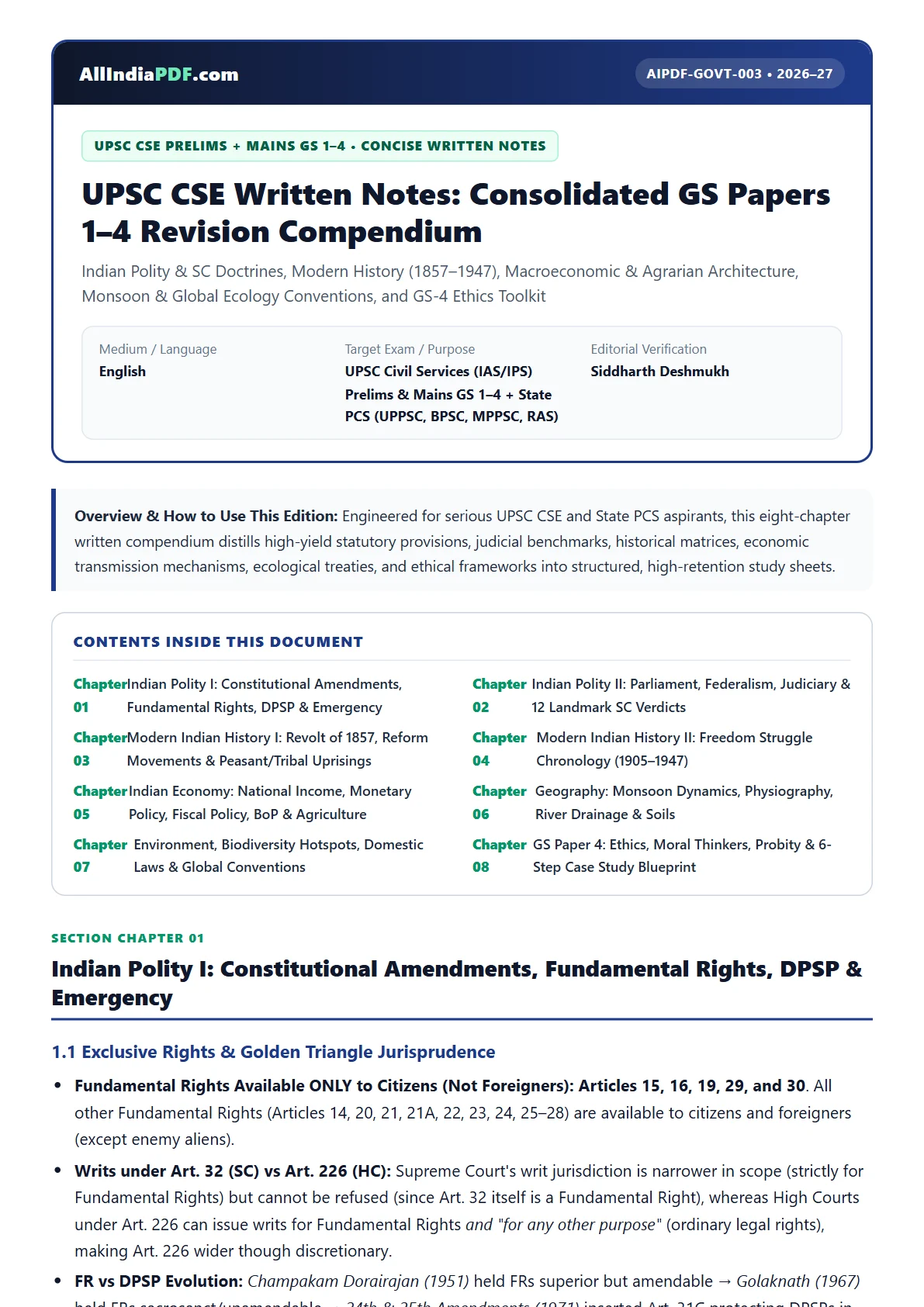
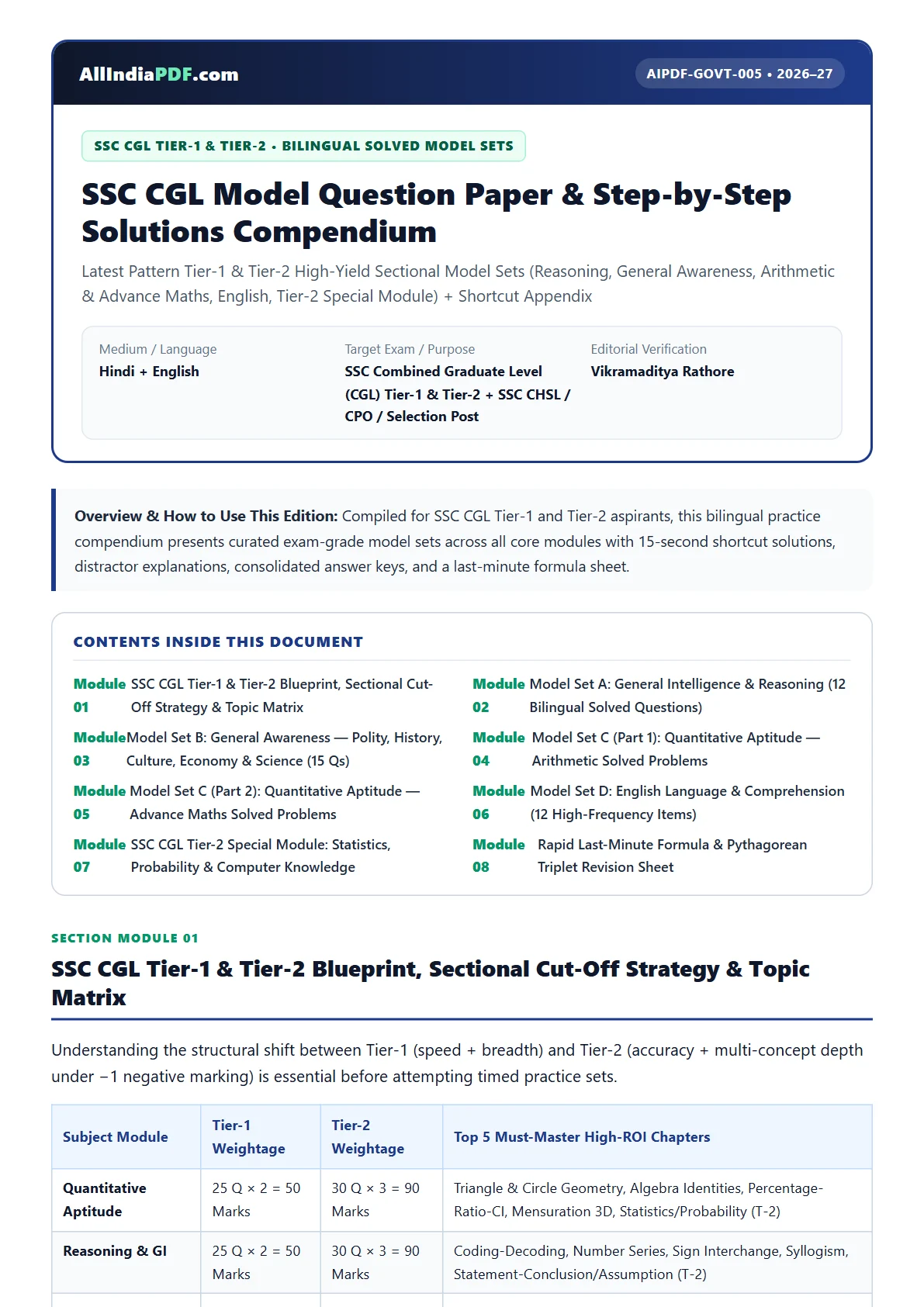
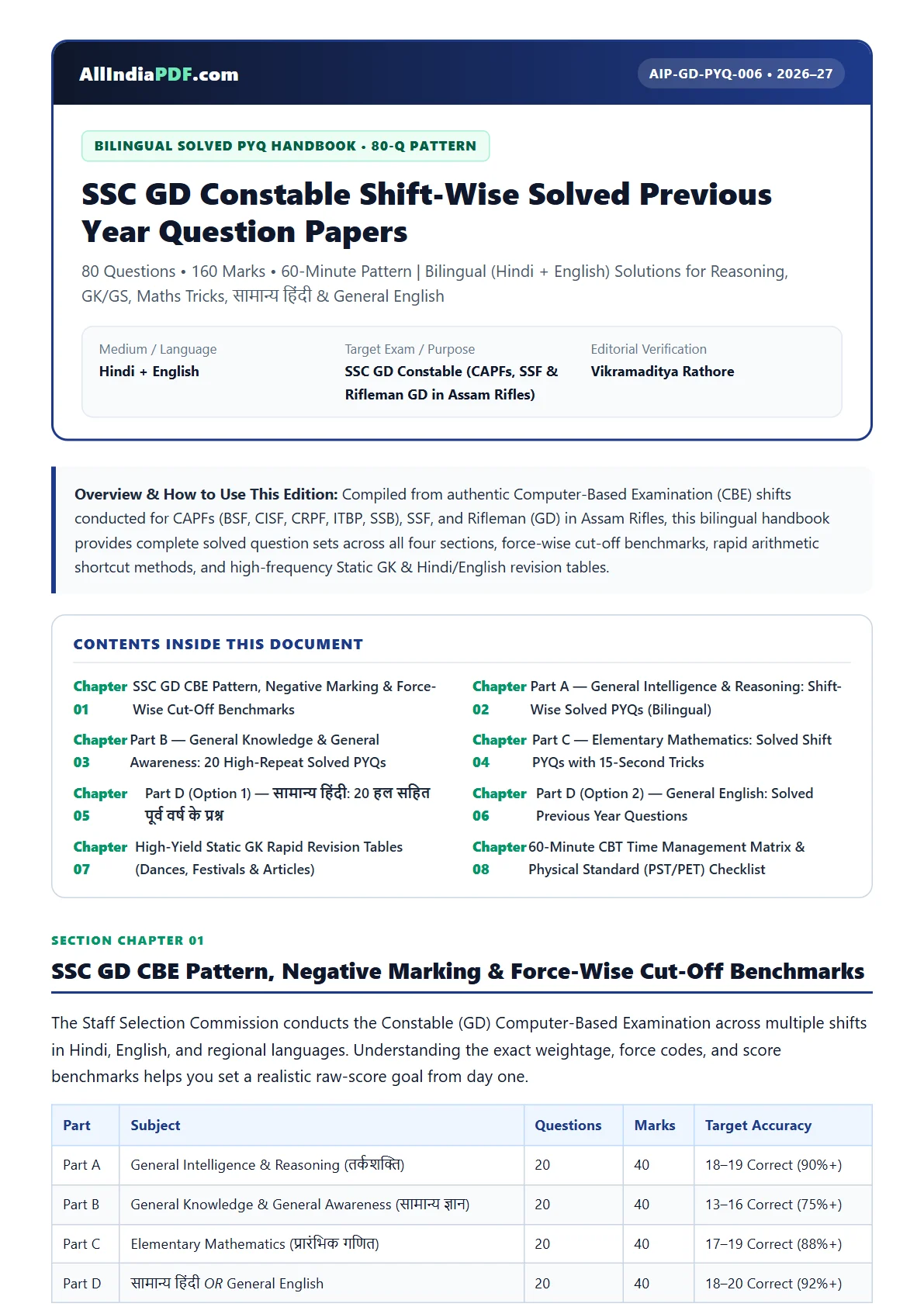
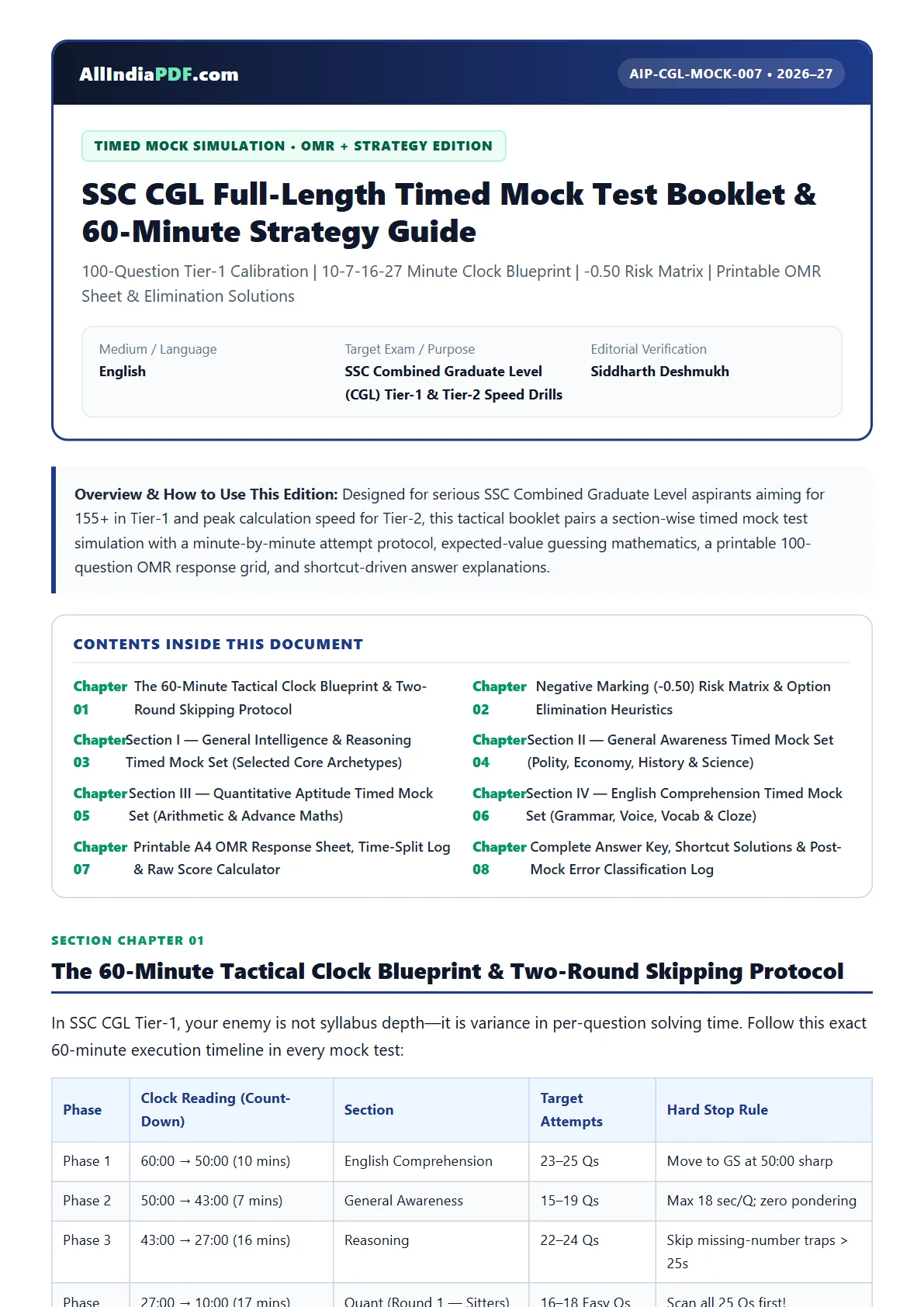
Inside Document Preview (Pages 1–3 of 10)
Actual print-ready pages from the verified 2026–27 PDF compilation.
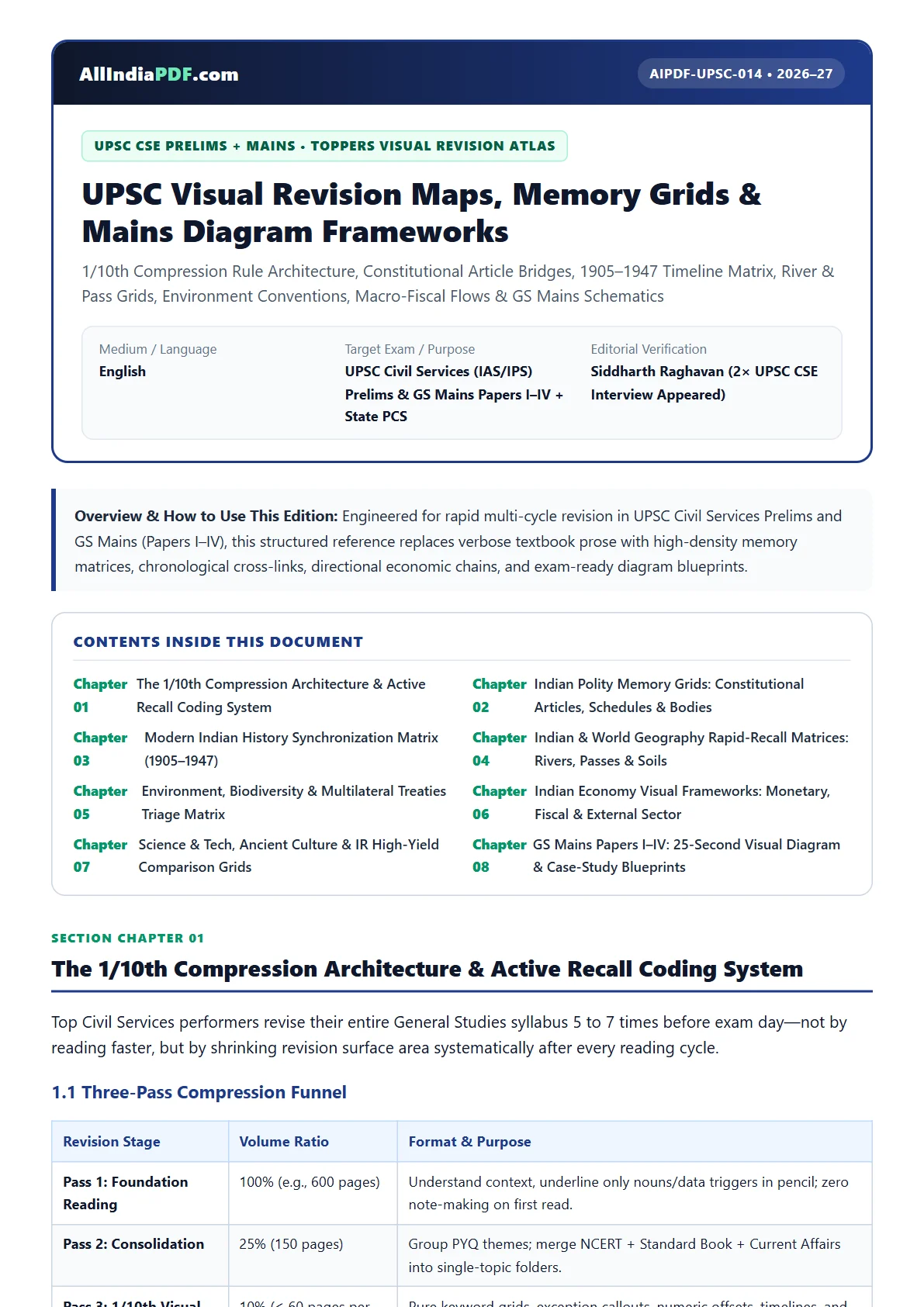
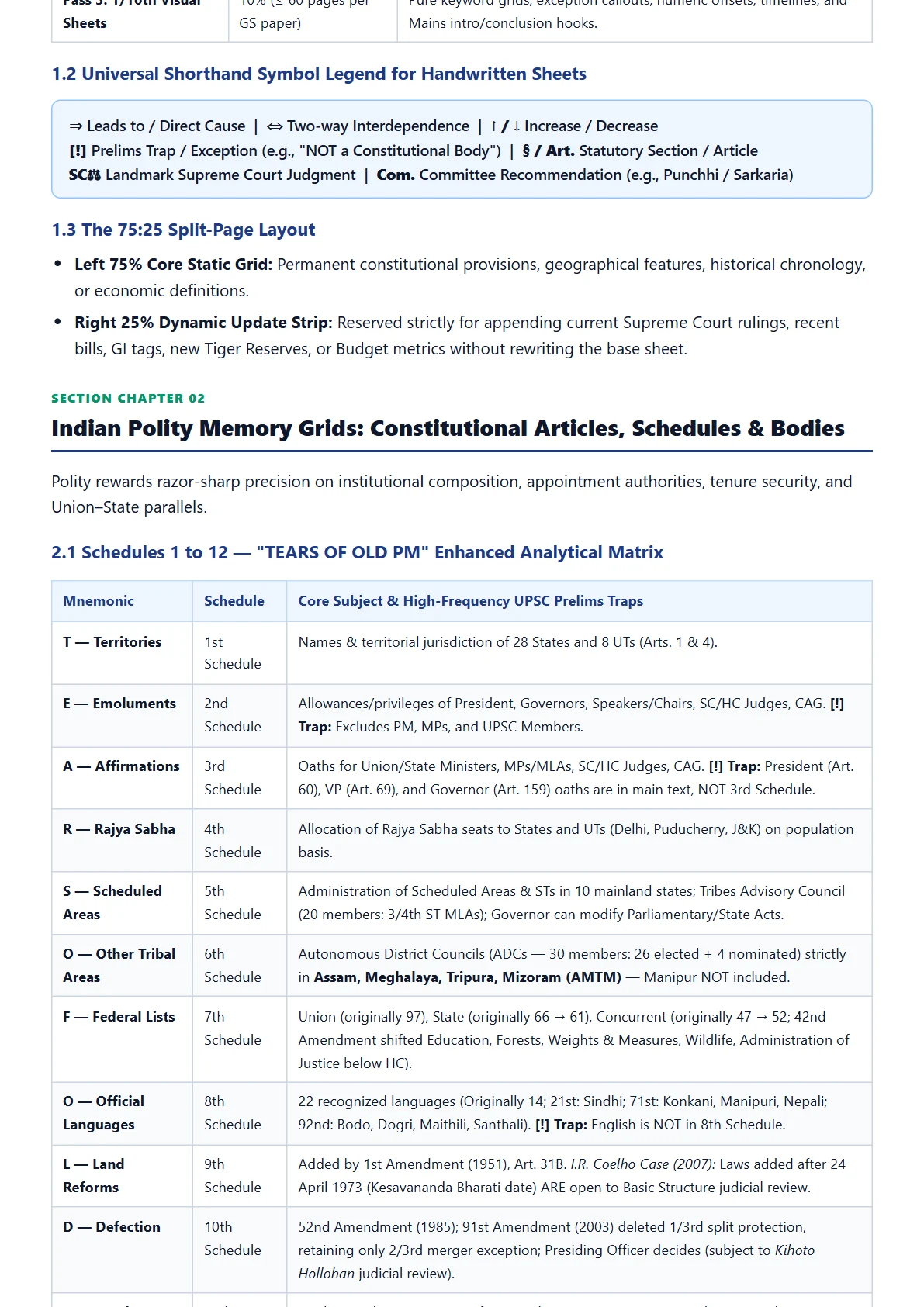
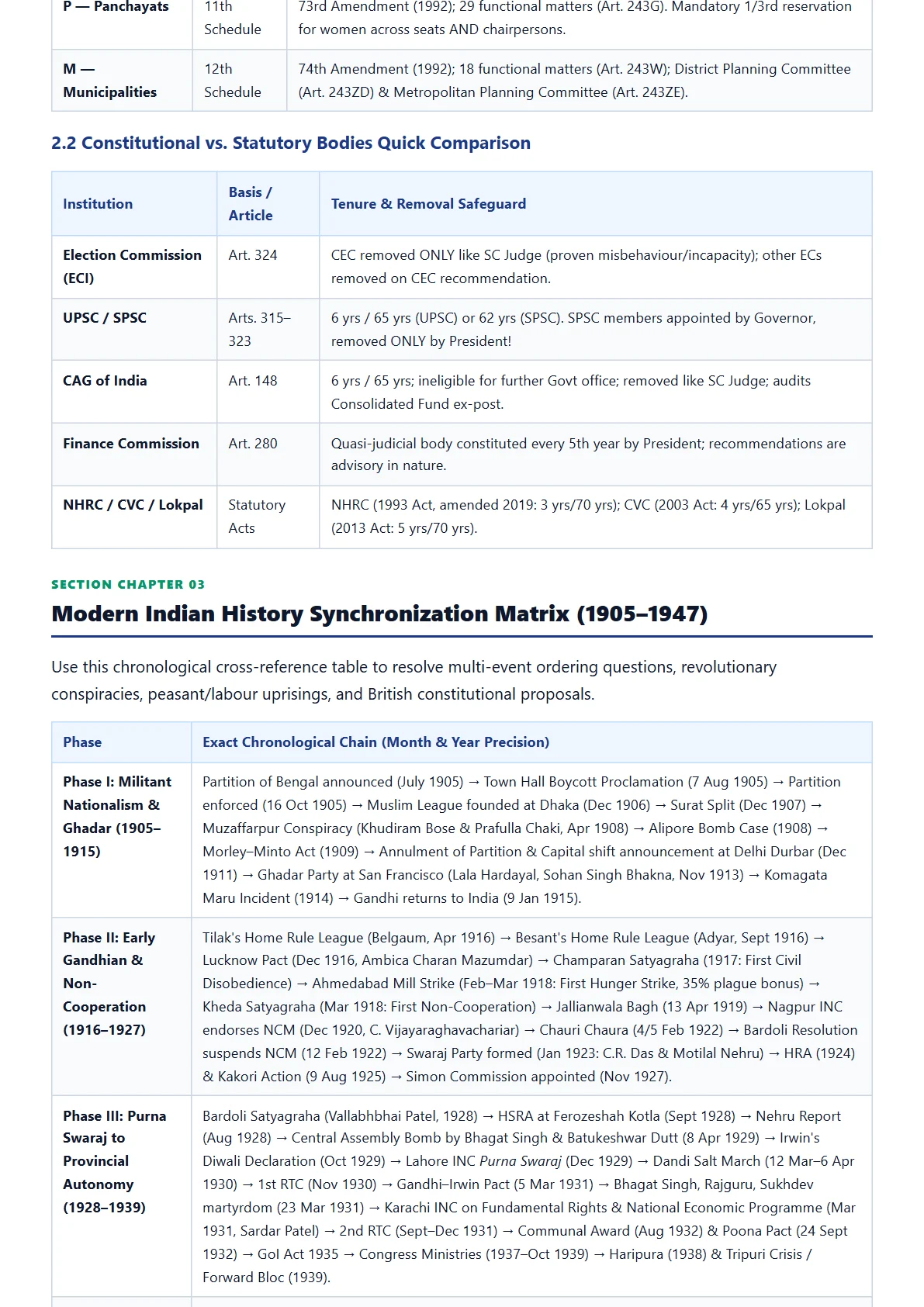
Continue Reading All 10 Full Pages Offline
Verify your email address to access the complete 10-page printable PDF with all chapters, tables, and solved examples.
In This Study Guide
- 1.1. The 1/10th Compression Rule & Symmetric Constitutional Memory Grids
- 2.2. Chronological Matrix Architecture: Freedom Struggle (1905–1947)
- 3.3. Geography, Environment & Macro-Economy Flow Frameworks
- 4.4. GS Mains 25-Second Visual Presentation & Diagram Blueprints
- 5.Complete PDF Chapter Breakdown
- 6.Frequently Asked Questions
Key Highlights
- Engineered strictly around the 1/10th Compression Rule—distilling 300-page standard textbooks into crisp 30-page visual triggers instead of bulky prose paragraphs
- High-Yield Constitutional Memory Grids pairing Union–State symmetric articles (+89/+90 offset trick), Schedules 1–12, and Landmark Amendments
- Chronological Freedom Struggle Matrix (1905–1947) linking Viceroys, INC Sessions, Gandhian Movements, and Constitutional Acts side by side
- Prelims Elimination Tables for Himalayan Passes, Peninsular River Tributaries, Biosphere Reserves, Ramsar Clusters, and Multilateral Climate Treaties
- Ready-to-Replicate GS Mains Micro-Diagrams (Hub-and-Spoke, PESTEL Hexagon, Stakeholder Triangle, Constitutional Arc, and India Schematic Maps) executable in under 25 seconds
Every serious Civil Services aspirant eventually confronts the revision bottleneck: between Prelims test series and the five-day Mains marathon—where General Studies Papers I, II, III, and IV leave barely three hours between morning and afternoon shifts—re-reading bulky 700-page prose textbooks is physically impossible. That is precisely why toppers rely on structured handwritten notes UPSC visual sheets rather than copied paragraphs.
Unlike conventional narrative chapter summaries that simply rewrite standard reference books in smaller handwriting, high-scoring toppers-style UPSC visual revision maps operate on spatial memory, side-by-side comparison grids, mathematical article offsets, causal arrow chains, and 25-second Mains schematics. This guide breaks down the exact visual note-making methodology across Polity, Modern History, Geography, Environment, Economy, and Mains Answer Presentation so you can recall dense factual clusters under severe exam-hall time pressure.
⇒ causal arrows, exception badges, and comparative matrices.
1. The 1/10th Compression Rule & Symmetric Constitutional Memory Grids
Why do aspirants forget Articles 163–213 despite memorizing Articles 74–123 multiple times? Because linear reading isolates Union and State provisions into separate chapters. In visual handwritten notes UPSC grids, Union and State articles are mapped side by side using the famous +89 and +90 Arithmetic Bridge (valid across most provisions from Article 72 to Article 111, and +90 from Article 112 to Article 123):
| Constitutional Provision | Union Executive / Parliament | Offset Rule | State Executive / Legislature |
|---|---|---|---|
| Pardoning Power | Article 72 (President: includes Court Martial & Death Sentence pardon) | + 89 | Article 161 (Governor: no Court Martial; commutation/remission scope) |
| Council of Ministers to Aid & Advise | Article 74 (Binding after 42nd & 44th Amendments) | + 89 | Article 163 (Includes constitutional discretion sphere of Governor) |
| Law Officer of Government | Article 76 (Attorney General of India) | + 89 | Article 165 (Advocate General of State) |
| Money Bill Definition | Article 110 (Speaker's certification final) | + 89 | Article 199 (Assembly Speaker's certification) |
| Annual Financial Statement (Budget) | Article 112 (Union Budget) | + 90 | Article 202 (State Budget) |
| Ordinance-Making Power | Article 123 (President — max 6 months + 6 weeks) | + 90 | Article 213 (Governor — parallel recess condition) |
By anchoring six Union numbers in memory, twelve high-frequency Prelims articles lock into place instantaneously, while the rightmost column highlights only the constitutional exceptions that UPSC examiners love testing in multi-statement questions.
2. Chronological Matrix Architecture: Freedom Struggle (1905–1947)
In UPSC Prelims, Modern Indian History questions frequently ask candidates to arrange four events in strict chronological sequence or connect a mass agitation with simultaneous revolutionary, legislative, or Viceregal developments. Prose notes obscure simultaneous timelines; a 4-column synchronized timeline matrix makes cross-era links unmistakable:
| Year & Viceroy | Mass / INC Milestone | Key Personalities & Texts | British Response / Constitutional Shift |
|---|---|---|---|
| 1905–1907 (Curzon → Minto II) |
Swadeshi & Boycott Movement (7 Aug 1905); Calcutta INC (1906: Swaraj); Surat Split (1907) | Dadabhai Naoroji, Lal–Bal–Pal, Aurobindo Ghosh, Rabindranath Tagore (Amar Sonar Bangla) | Carlyle Circular; Prevention of Seditious Meetings Act (1907); Morley–Minto Reforms (1909 Separate Electorates) |
| 1916–1919 (Chelmsford) |
Home Rule Leagues (Tilak Apr 1916, Besant Sept 1916); Lucknow Pact (1916); Champaran, Ahmedabad, Kheda; Rowlatt Satyagraha (1919) | B.G. Tilak, Annie Besant, M.K. Gandhi, Rajkumar Shukla, Saifuddin Kitchlew | Montagu Declaration (Aug 1917); GoI Act 1919 (Provincial Dyarchy); Hunter Committee post-Jallianwala Bagh |
| 1928–1932 (Irwin → Willingdon) |
Anti-Simon Protests; Nehru Report (1928); Lahore INC Purna Swaraj (Dec 1929); Dandi March (12 Mar–6 Apr 1930) | Motilal Nehru, Jawaharlal Nehru, Khan Abdul Ghaffar Khan (Khudai Khidmatgars), Sarojini Naidu, B.R. Ambedkar | Gandhi–Irwin Pact (5 Mar 1931); Three Round Table Conferences (1930–32); Communal Award & Poona Pact (Sept 1932) |
| 1940–1947 (Linlithgow → Wavell → Mountbatten) |
Individual Satyagraha (Oct 1940: Vinoba, Nehru, Brahma Dutt); Quit India (8 Aug 1942); INA Trials & RIN Mutiny (Feb 1946) | Aruna Asaf Ali, Usha Mehta (Underground Radio), Subhas Chandra Bose, Bhulabhai Desai | August Offer (1940) → Cripps Mission (1942) → Wavell Plan (1945) → Cabinet Mission (May 1946) → Indian Independence Act (1947) |
3. Geography, Environment & Macro-Economy Flow Frameworks
Nearly 35–42% of Prelims GS Paper-I stems from Geography, Environment-Ecology, and Indian Economy—three domains dominated by spatial arrangement and directional causation. Toppers convert these topics into compact arrow chains and left/right matrices rather than descriptive essays:
- Drainage Bank Matrix: Instead of memorizing river paragraphs, split every basin into Left-Bank (North/East joining) vs. Right-Bank (South/West joining) rows—for example, Godavari Left-Bank: Purna, Pranhita (Wardha + Wainganga + Penganga), Indravati, Sabari; Godavari Right-Bank: Pravara, Manjira (Nizam Sagar), Manair.
- Environment Convention Triage Grid: Group international treaties by Secretariat/Host Body (UNEP vs. IUCN vs. UNCCD), legal binding status (Binding vs. Non-Binding), and Financial Mechanism (GEF operational focal points: CBD, UNFCCC, UNCCD, Stockholm POPs, Minamata Mercury).
- Monetary-Fiscal Causal Chains: Capture RBI and Union Budget mechanics as directional strings so conceptual Prelims traps become effortless to eliminate:
CPI Inflation > 6% Upper Tolerance Band ⇒ RBI Hikes Repo Rate ⇒ Commercial Bank Borrowing Cost ↑ ⇒ Lending Rates (MCLR / EBLR) ↑ ⇒ Credit Expansion & Aggregate Demand Moderate ⇒ Demand-Pull Inflation Cools (Trade-off: Short-run GDP Growth Momentum Slows).
4. GS Mains 25-Second Visual Presentation & Diagram Blueprints
In UPSC Mains, an examiner evaluates 20 dense answers per script across thousands of booklets. Breaking monotonous text blocks with one crisp, relevant schematic diagram per 10-marker or 15-marker answer immediately signals analytical clarity without sacrificing word-limit discipline:
- Hub-and-Spoke Cluster (Best for Multi-Dimensional Impacts): Place the central theme (e.g., National Green Hydrogen Mission) inside a central box and radiate 5–6 concise spokes—Energy Security, Decarbonizing Steel/Fertilizers, Export Competitiveness, Electrolyzer Manufacturing, CAD Reduction, and Net-Zero 2070.
- 3-Tier Stakeholder Triangle (Best for GS-2 Governance & GS-4 Ethics): Map State / Regulatory Institutions at the apex, Market / Private Innovators at the bottom-left, and Civil Society / Citizens (Gram Sabha) at the bottom-right to illustrate collaborative governance (Jan Bhagidari).
- Input → Process → Outcome Pipeline (Best for Policy Reform Questions): Show Bottlenecks on the left (Fragmented Land Holdings, Post-Harvest Losses), Institutional Interventions in the center (FPOs, e-NAM, Cold-Chain Infrastructure), and SDG-Aligned Outcomes on the right (Doubling Real Farm Incomes, Nutritional Security).
- Micro-Map Insertion Rule: Practice sketching a clean 15-second outline of Peninsular India or the Indo-Pacific rim to plot Lithium reserves, Dedicated Freight Corridors, Cyclone tracks, or IMEC trade corridors directly beside your analysis.
What’s Included Inside the Complete 10-Page PDF
Structured specifically for fast revision, exam hall recall, and clean A4 printing:
The 1/10th Compression Architecture & Margin Coding System
Exact methodology used by top-rankers to condense Laxmikanth, Spectrum, GC Leong, and Economic Survey chapters into single-sheet trigger grids.
Indian Polity Symmetric Article Grids & Schedules Matrix
President vs. Governor, PM vs. CM, Parliament vs. State Legislature (+89/+90 numeric bridge), Fundamental Rights vs. DPSP, and Constitutional Bodies table.
Modern Indian History Timeline Matrix (1905–1947)
Synchronized year-by-year grid from Swadeshi Movement (1905) to Independence Act (1947) for solving tricky chronological arrangement MCQs in Prelims.
Geography & Environment Rapid-Recall Matrices
Left-bank vs. right-bank river tributaries, North-to-South mountain passes, 18 Biosphere Reserves with key fauna, and COP/Treaty mandate comparison tables.
Indian Economy Fiscal–Monetary Transmission Flows
Visual arrow-chains mapping Repo/SDF tightening, inflationary liquidity cycles, Balance of Payments (Current vs. Capital Account), and Deficit formulas.
GS Mains 25-Second Answer Presentation Blueprints
12 plug-and-play structural diagrams for GS-1, GS-2, GS-3, and GS-4 Ethics case studies to elevate visual appeal and secure +1 to +1.5 extra marks per question.
Ready to download the full 10-page printable PDF?
Instant access + backup copy delivered straight to your verified email address.
Frequently Asked Questions
How are visual UPSC handwritten-style notes different from regular summary notes?+
Regular summary notes condense chapters into shorter prose paragraphs, whereas visual revision sheets apply the 1/10th Compression Rule—transforming concepts into side-by-side comparison matrices, chronological timelines, causal arrow chains, and 25-second Mains diagrams designed for rapid visual recall.
When should a UPSC aspirant switch from standard textbooks to compressed revision grids?+
Standard foundation books (like Laxmikanth, Spectrum, or NCERTs) should be read thoroughly once or twice first to build conceptual context. Compressed visual grids become your primary weapon during the final 75 days before Prelims and the intense gap days during GS Mains.
Do flowcharts and diagrams genuinely improve marks in UPSC GS Mains papers?+
Yes, when used judiciously and anchored to relevant content. A crisp 20-second schematic diagram, value-chain flowchart, or mini regional map breaks visual monotony, lets you present 5–6 dimensions concisely within the 150/250-word limit, and helps the evaluator grasp your structure immediately.
Are these Polity, History, Geography, Environment, and Economy grids useful for State PCS exams too?+
Absolutely. State Civil Services examinations—including UPPCS, BPSC, MPPSC, RAS, MPSC, and KAS—heavily test Constitutional Articles, Schedules, 1905–1947 Freedom Struggle chronology, River Tributaries, Biosphere Reserves, and GS Mains structured answer formats.
How can I customize compressed visual revision sheets with current affairs updates?+
Follow the 25% Open Margin Principle: keep a narrow annotation column beside every static grid so you can append Supreme Court judgments, latest Constitutional Amendments, newly notified Ramsar wetlands, or Economic Survey indicators directly next to the core static concept.
Editorial Accuracy & Syllabus Verification (2026–27)
This guide was compiled by Siddharth Raghavan (2× UPSC CSE Interview Appeared) (Senior General Studies Mentor & Visual Note-Architecture Specialist) and reviewed by Dr. Aniruddha Menon (Faculty of Constitutional Law & Public Policy) in accordance with our Editorial Policy. Found a syllabus update or typo? Write to support@allindiapdf.com.